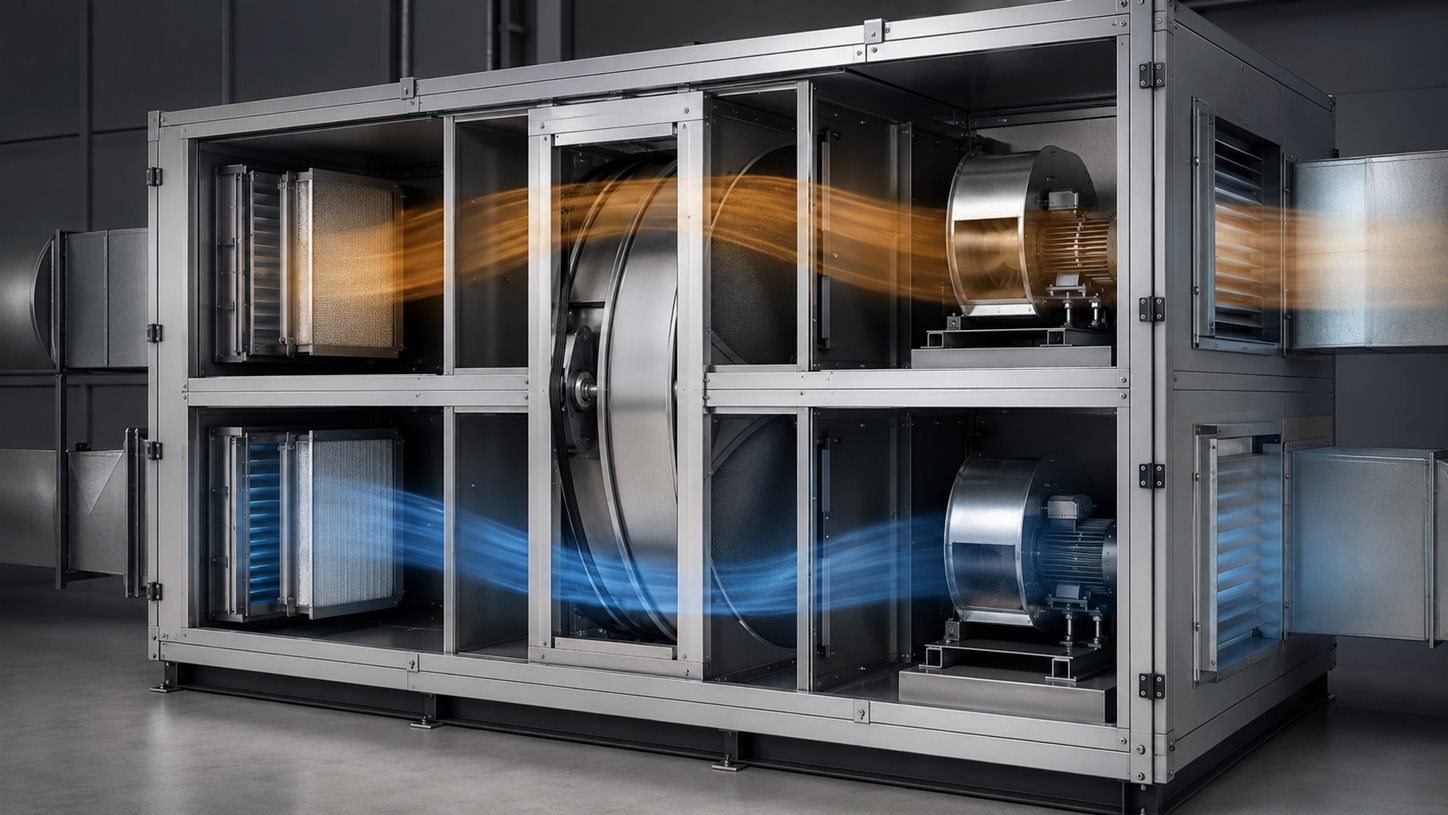
Ventilation has one unwelcome characteristic: it constantly expels air from the building that you have already paid to condition. Warm air in winter. Cooled air in summer. In the dry season, air containing moisture that had to be added or retained inside the building.
A rotary heat exchanger is designed specifically to recover some of that energy.
But there is an important nuance. Simply having a rotor in the unit does not guarantee savings. The rotor may appear in the design, the cost estimate and the equipment datasheet, yet operate in name only. Not optimally, not according to enthalpy, and not in response to actual building conditions.
What a rotary heat exchanger recovers
A rotary heat exchanger is a rotating heat exchanger between the extract and supply air streams.
In a typical application, it can recover:
- heat in winter
- cooling in summer
- some moisture
- some of the energy that ventilation would otherwise simply discharge outdoors.
For offices, retail areas, educational buildings, public spaces and commercial premises with high ventilation rates, this is no longer an “optional extra”. It is a component that can affect energy bills.
Where rotary heat recovery makes sense
A rotary heat exchanger is suitable where extract air is relatively clean:
- office centres
- business centres
- retail areas
- teaching spaces
- public buildings
- hotels
- fitness areas without specific contaminants
- commercial premises with high, continuous ventilation rates.
It must not be installed indiscriminately everywhere. Kitchens, toilets, laboratories and areas with odours, moist or contaminated extract air require a separate approach. Risks of air leakage between streams, odour transfer and hygiene, as well as proper separation of air streams, are important here.
So the question is not whether “a rotor is good”. It is where it is installed, what exactly it recovers and how the controls manage it.
Worked example
Consider an office building:
This is not a universal promise of savings. It is a calculation model showing the order of magnitude.
1. Heat recovery in winter
At an airflow rate of 30 000 m³/h and a temperature difference of 27 °C, ventilation removes approximately the following from the building:
≈ 270 kW of thermal power
If the rotor recovers 80% of the heat:
270 kW × 80% = 216 kW
Over 1 200 hours of winter operation:
216 kW × 1 200 h = 259 200 kWh of heat
If heating is provided by a system with a COP of 3, the electricity savings are:
259 200 / 3 = 86 400 kWh
In monetary terms:
86 400 × UAH 13 = UAH 1 123 200/year
So, from winter heat recovery alone:
≈ UAH 1.1 million per year or ≈ UAH 112/m² per year
If ventilation top-up heating used direct electric resistance heating instead, without a COP multiplier, the same thermal energy saving could be worth around:
≈ UAH 3.37 million/year
2. Moisture recovery in winter
During the dry winter period, ventilation creates another cost: the need for humidification.
For a 10 000 m² office centre with a ventilation rate of 30 000 m³/h, the humidification requirement may be approximately:
≈ 160 kg of water per hour
If a sorption or enthalpy rotor recovers 60% of the moisture:
160 kg/h × 60% = 96 kg/h
This is moisture that no longer needs to be supplied by central humidification.
For steam humidification, the approximate energy required per kilogram of moisture is about 0.68 kWh/kg; Condair gives this figure in its explanation of humidification energy use.
Calculation:
96 kg/h × 0.68 kWh/kg × 1 200 h = 78 336 kWh/year
In monetary terms:
78 336 × UAH 13 = UAH 1 018 368/year
So, for moisture recovery:
≈ UAH 1,0 million per year or ≈ UAH 102/m² per year
This is an important figure. Humidity is often seen as a matter of ‘comfort’, but in practice it is also a separate energy cost.
3. Summer: cooling recovery and reduced latent load
In summer, the wheel transfers energy in the opposite direction. It recovers some cooling from the extract air and reduces the load on the cooling system. An enthalpy or sorption wheel can also reduce the latent load on the air conditioning system.
For our 30 000 m³/h example, a conservative estimate is:
≈ UAH 0,3–0,5 million/year
or:
≈ UAH 30–50/m² per year
A range is more appropriate here, as summer savings depend heavily on outdoor air humidity, building operating schedules, free cooling modes, indoor temperatures and system COP.
Overall savings from the wheel
If the supplementary heating system uses direct electric heating rather than operating at a COP of 3, the potential savings may be even higher.
In this case, winter heat recovery alone could save around UAH 3,37 million/year, with total savings from the wheel approaching:
≈ UAH 4,6–4,9 million/year
CAPEX: what the wheel can reduce
A rotary heat exchanger affects more than just OPEX.
It can reduce installed system capacities:
This does not always translate automatically into CAPEX savings in the cost estimate. However, at the design stage it can influence:
- heating coil capacity
- heat pump or chiller capacity
- electrical capacity requirements
- humidification system capacity
- associated pipework
- controls
- redundancy
operating costs for years to come. The wheel should therefore be assessed not as a ‘more expensive AHU section’, but as a component that changes the building’s energy balance.
The main problem: the wheel is often there in name only
In practice, a rotary heat exchanger is often installed but does not deliver its full potential savings. Why? Because it has been treated as a piece of equipment rather than a component requiring appropriate operating modes.
It simply rotates. Or simply switches on. Or is simply included in the unit’s standard controls.
But building operation is more complex. In winter, heat and moisture need to be recovered. In summer, cooling and some dehumidification capacity. During the shoulder seasons, the wheel must not impede free cooling. At high humidity, enthalpy must be considered alongside temperature. With varying operating schedules, the mode must adapt to the actual load.
Without this, the wheel’s rated efficiency does not translate into financial savings.
Rated efficiency and actual savings are different things
A wheel has two different measures of efficiency. The first is its rated efficiency, stated by the manufacturer.
The second is its operational efficiency, which the owner sees in the bills. The gap between the two often amounts to millions of hryvnias.
For example, if the wheel’s potential savings for a property are:
≈ UAH 2,5 million/year
but basic control logic allows the system to realise only 50% of that potential, the actual savings will be:
≈ UAH 1,25 million/year
And the lost savings:
≈ UAH 1,25 million/year
In other words, the owner may think they have a wheel. Financially, however, they only have half a wheel.
How to design a rotary heat recovery system
A rotary heat exchanger should not be designed merely as a section of an AHU.
Its operating modes must be designed from the outset.
The design must clearly establish:
- when the wheel operates at maximum output
- when it reduces speed
- when it stops
- when the bypass is used
- when the system switches to free cooling
- which sensors are required
- whether humidity is taken into account
- whether enthalpy is calculated
- how the BMS displays actual operation
- who oversees seasonal settings
- how the supply/extract air balance is checked
- what happens when filters become dirty
- which faults shut down the wheel
how the owner can see whether the system is delivering financial savings. Without this, the wheel remains an expensive component in an AHU. With it, the wheel becomes a key part of the building’s energy system.
Conclusion
A rotary heat exchanger is not simply a way to make ventilation ‘energy-efficient’.
For a 10 000 m² office building, its savings could amount to:
≈ UAH 1,1 million/year from winter heat recovery; ≈ UAH 1,0 million/year from moisture recovery; ≈ UAH 0,3–0,5 million/year from summer operation.
Total:
≈ UAH 2,4–2,6 million/year or ≈ UAH 240–260/m² per year
But these savings are not guaranteed. They are potential savings. To turn them into real money, the wheel must do more than simply run: it needs the right control logic, covering temperature, humidity, enthalpy, free cooling, air balance, BMS integration and trend monitoring.
The question is not whether the design includes a wheel. It is whether that wheel delivers financial savings per square metre. When it operates correctly, it recovers heat, cooling, moisture and money for the owner. When it operates in name only, it simply rotates.
When moisture recovery also matters
When comparing heat exchangers, temperature efficiency and moisture transfer should be checked separately for the specific heat exchanger configuration. An example using an enthalpy heat exchanger shows how moisture recovery relates to an office’s humidification requirements and which assumptions need to be checked in the calculation.