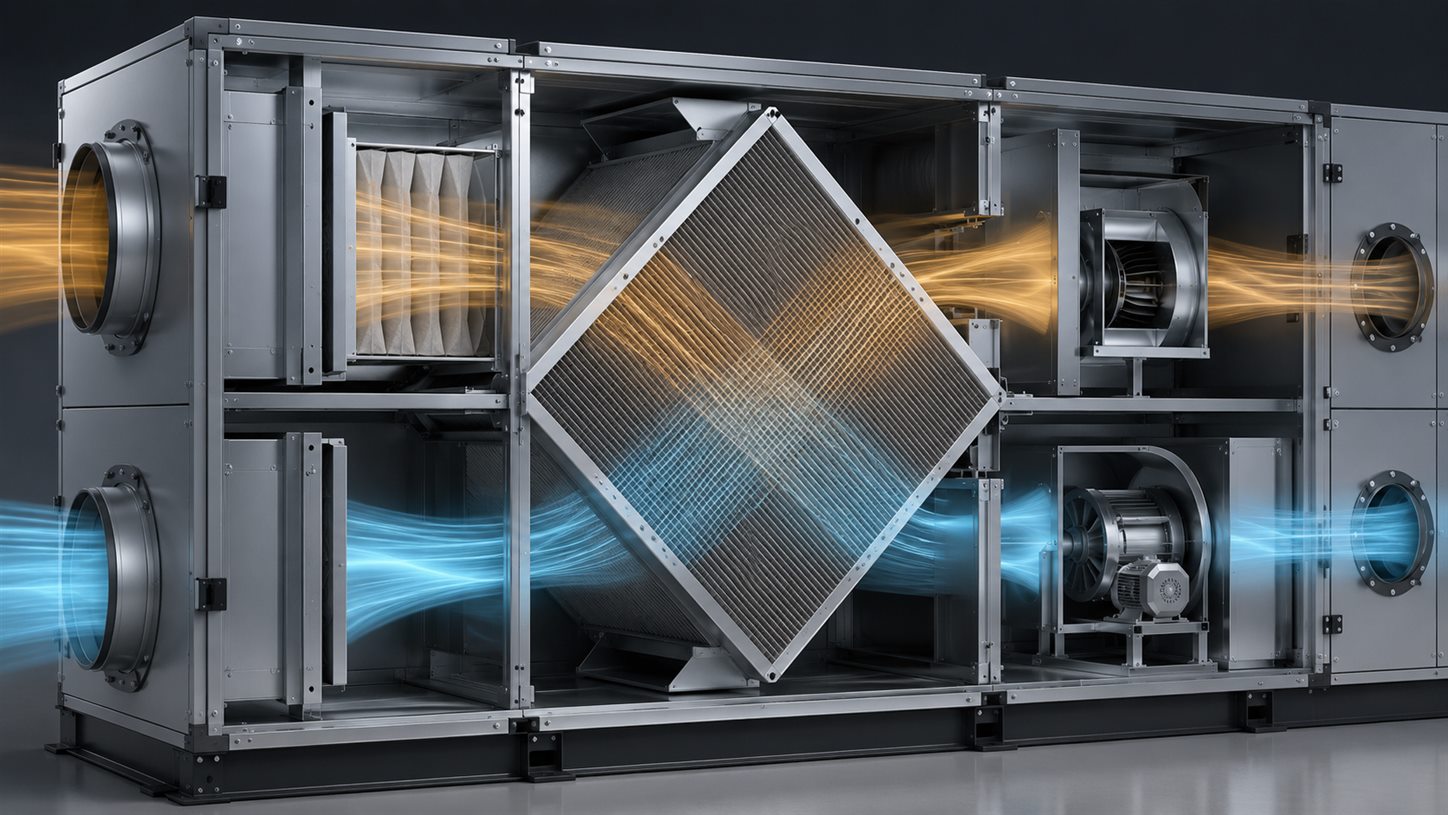
This article looks at EHRV — an enthalpy heat exchanger: a ventilation heat exchanger that recovers not only heat, like a conventional HRV, but also some of the moisture from the extract air.
1. Heat recovery
In winter, the extract air from an office is already warm. The heat exchanger transfers some of this heat to the supply air. A lower heating load. A lower peak load. Smoother system operation.
2. Moisture recovery
This is the main difference between an ERV and a conventional heat exchanger. In winter, an office exhausts air containing moisture from people, processes and the indoor environment. An enthalpy heat exchanger transfers some of this moisture back into the supply air.
3. Less need for central humidification
If an office aims to maintain 40% relative humidity in winter, a substantial amount of moisture must be added artificially without moisture recovery. An ERV does not create moisture from nothing. But it reduces the amount that needs to be added.
4. Lower summer loads
In summer, outdoor air can be humid as well as warm. An enthalpy heat exchanger reduces both the sensible and latent loads on the cooling system to some extent. This matters for VRF systems, fan coil units, chillers and any air conditioning system.
Worked example
Consider an office building:
The cost of humidification without an ERV
For an office building of this size, the winter humidification requirement may be approximately:
160 kg of water per hour
For steam humidification, we assume:
0,68 kWh per 1 kg of water
This gives:
160 kg/h × 0,68 kWh × 1 200 h = 130 560 kWh/year
In monetary terms:
130 560 kWh × 13 UAH = 1 697 280 UAH/year
So, for a 10 000 m² office:
≈ UAH 1,7 million per year or ≈ UAH 170/m² per year
This covers humidification energy only. It excludes servicing, water treatment, repairs, consumables and equipment depreciation.
What ERV changes
If the enthalpy heat exchanger recovers approximately 50% of the moisture, the need for active humidification falls by approximately:
80 kg/h
Energy savings:
80 kg/h × 0,68 kWh × 1 200 h = 65 280 kWh/year
Cost savings:
65 280 kWh × UAH 13 = UAH 848 640/year
In other words:
≈ UAH 850 000 per year or ≈ UAH 85/m² per year
The economics for 10 000 m²
CAPEX: savings on central humidification
There are two scenarios.
Scenario 1. Humidification is still required
If the specification strictly requires 40–45% RH to be maintained, ERV does not replace central humidification entirely. However, it can reduce the required capacity.
Indicative CAPEX savings:
UAH 80–180/m²
For a 10 000 m² office centre:
≈ UAH 0,8–1,8 million
These savings come from reduced humidifier capacity, electrical power requirements, associated pipework, controls, and steam or water distribution.
Scenario 2. Central humidification can be omitted
If there is no strict requirement to maintain 40–45% RH, and the aim is to reduce excessive air dryness and improve comfort, ERV may allow a full central humidification system to be omitted.
Indicative avoided CAPEX:
UAH 150–350/m²
For a 10 000 m² office centre:
≈ UAH 1,5–3,5 million
However, this needs to be stated honestly:
ERV is not a complete replacement for a humidification system where humidity is a mandatory controlled parameter. However, it can significantly reduce humidification demand or eliminate the need for an expensive central system where the aim is normal office comfort rather than laboratory precision.
Comfort in figures
Without moisture recovery, winter supply air can have very low relative humidity after heating.
In a real office, this often looks like this:
So ERV does not always bring an office up to the ideal 40–45%, but it can provide an increase of:
+8–15 percentage points of relative humidity
For occupants, this is already a noticeable difference. The temperature may be the same — 22 °C — but the air will feel different.
Free cooling
ERV is also important during the shoulder seasons. In spring, autumn, mornings or evenings, outdoor air may be cool enough to cool the office without compressor-based cooling. However, free cooling needs more than basic control.
Simply opening the bypass and supplying outdoor air directly is not enough. The following need to be assessed:
- outdoor air temperature
- humidity
- enthalpy
- CO₂
- internal heat gains
the building's operating schedule.
A correctly configured ERV with a bypass allows the operating mode to be selected:
Common mistakes
Selecting ERV without calculating the moisture balance. Comparing temperature alone rather than enthalpy. Not using the bypass for free cooling.
Not integrating ventilation with air conditioning. Not installing suitable temperature, humidity and CO₂ sensors. Not providing access to the filters and heat exchanger.
Including heat recovery as a box-ticking exercise without developing operating-mode logic.
Conclusion
An enthalpy heat recovery unit is not simply a more expensive air handling unit.
For an office centre, it is an engineering component that can influence three things at once:
energy, humidity and comfort.
For the example of a 10 000 m² office, moisture recovery could deliver approximately:
≈ UAH 850 000 in annual savings ≈ UAH 85/m² per year ≈ UAH 0,8–1,8 million in CAPEX savings with reduced humidification capacity, or ≈ UAH 1,5–3,5 million in avoided CAPEX if central humidification is not required
So the question is not whether the design includes heat recovery.
The real question is:
which type of heat exchanger is used, what it recovers, how it is controlled, and whether its technology translates into real financial benefits for the building owner.
How to check this example against your own office
The financial figures presented are a calculated scenario, not measured results for every building. Moisture recovery of 50%, 1 200 hours of humidification operation and an electricity tariff of UAH 13/kWh are assumptions used in the example. Before selecting a unit, check:
- Which supply and extract air flow rates and winter conditions are used in the moisture balance calculation.
- What moisture recovery is verified for the specific heat exchanger under these conditions, and what limitations apply to its use.
- Whether there is a mandatory humidity setpoint and, if so, how much additional humidification capacity is needed after recovery.
- How the actual operating schedule, tariff, maintenance and bypass control will affect the annual result.
For a comparison of temperature efficiency and overall unit performance, see the heat recovery efficiency analysis.