
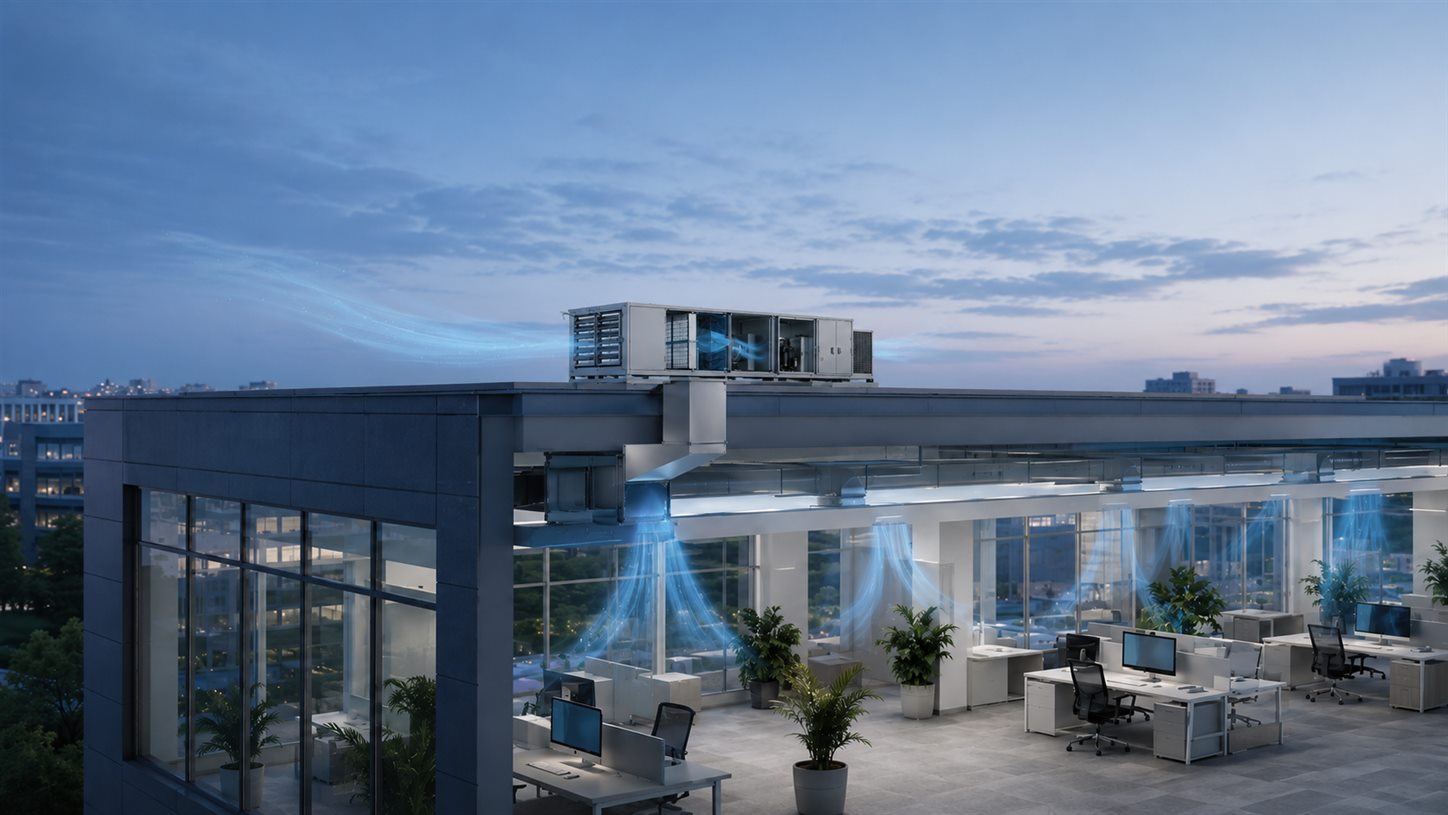
Many commercial buildings need cooling outside summer. An office, business centre or retail property may need cooling in spring, autumn and even on cool days. People are working. Lighting generates heat. Computers, server rooms, glazed façades and internal heat gains do not disappear.
Meanwhile, the outdoor temperature may be +8…+16 °C. This raises a very simple engineering question: why run the compressor when cool air is already available outside?
Free cooling is not “cooling at no cost”. It means hours when a building can be cooled without a compressor, or with a reduced compressor load.
Fans, damper actuators, controls, sensors and supervisory systems still operate. So free cooling is not cost-free. However, the most expensive part of cooling — the compressor cycle — can be stopped or delayed during this time.
Where free cooling makes sense
Free cooling works where a building has internal heat gains and long operating hours throughout the year. It is not limited to data centres and process cooling. It can also deliver genuine financial benefits in commercial property.
- office and business centres
- retail spaces
- fitness clubs
- educational buildings
- public spaces
- properties with large open-plan spaces
- buildings with glazed façades
- commercial properties with high ventilation airflow rates.
The key condition is simple: the building needs cooling at a time when outdoor air can provide it more cheaply than the compressor.
What free cooling actually saves
Free cooling does not save “cooling” itself. It saves the electricity that the compressor would have used to produce that cooling.
If a building needs 100 kW of cooling and the cooling system operates at a COP of 3,2, the compressor will draw approximately:
100 / 3,2 = 31 kW of electrical power
If this 100 kW of cooling can be provided partly or entirely by outdoor air, the corresponding compressor power consumption is avoided. This is why the economics of free cooling follow a very straightforward calculation:
kW of cooling × operating hours / COP × electricity tariff
But there is an important adjustment. Additional fan operation must be taken into account. If free cooling requires a substantial increase in airflow, some of the compressor savings will be spent on fans. So the correct financial calculation is not “compressor consumption minus zero”, but avoided compressor costs minus additional ventilation costs.
Two different free cooling modes
Free cooling has two distinct applications in a commercial building. They should not be combined into a single abstract function.
1. Daytime free cooling
This mode is used when cooling is needed immediately. People, equipment, lighting and solar gains are raising the indoor temperature, while it is sufficiently cool outside.
In this mode, the air handling unit (AHU) opens the bypass, reduces or stops heat recovery, increases the outdoor air proportion and uses it to cool the rooms.
Daytime free cooling answers the question: can outdoor air replace some of the compressor-based cooling right now?
2. Night-time free cooling
This is a completely different mode. At night, occupants generally do not need cooling because the building is empty or nearly empty. But the building itself remains warm after the working day.
Heat accumulates in floor slabs, walls, furniture, internal zones, air, shafts, open-plan spaces and plant rooms. If the night is cool, ventilation can be forced to run at a higher airflow rate to remove this heat.
In the morning, the air conditioning starts in a building that has already been partially cooled, rather than one that is overheated.
Night-time free cooling is not about providing comfort at night. It reduces the morning cooling peak.
Worked example
Consider a hypothetical office centre with a floor area of 10 000 m². This is not a universal promise of savings, but a working model showing the order of magnitude.
For air-side free cooling, an approximate calculation is:
kW of cooling = airflow rate × 0,000335 × temperature difference
Here, 0,000335 is a simplified coefficient for air when calculating in m³/h and °C.
Daytime free cooling at the standard airflow rate
Assume the ventilation system supplies 30 000 m³/h and the temperature difference between indoor and outdoor air is 8 °C.
Cooling capacity:
30 000 × 0,000335 × 8 = 80 kW of cooling
If these conditions occur for 700 hours/year during the season, we get:
80 × 700 = 56 000 kWh of cooling
At a COP of 3,2, this corresponds to compressor electricity savings of:
56 000 / 3,2 = 17 500 kWh
At an electricity tariff of 13 UAH/kWh:
17 500 × 13 = 227 500 UAH/year
So daytime free cooling at the standard ventilation airflow rate delivers approximately:
≈ 230 000 UAH/year or ≈ 23 UAH/m² per year
Daytime free cooling at an increased airflow rate
If the system can increase airflow to 60 000 m³/h in free cooling mode, the cooling capacity rises:
60 000 × 0,000335 × 8 = 161 kW of cooling
Over 700 hours:
161 × 700 = 112 700 kWh of cooling
Compressor electricity savings:
112 700 / 3,2 = 35 219 kWh
In monetary terms:
35 219 × 13 = 457 847 UAH/year
So, at an increased airflow rate:
≈ 450 000 UAH/year or ≈ 45 UAH/m² per year
However, fan electricity consumption must be included here. If airflow resistance is high, filters are dirty and fans are operating at their limits, some of these savings will be lost.
Night-time free cooling
Now consider a different scenario. At night, ventilation operates not for the occupants, but to pre-cool the building.
We use an airflow rate of 60 000 m³/h, a temperature difference of 8 °C and a night-time operating period of 6 hours.
Night-time cooling capacity:
60 000 × 0,000335 × 8 = 161 kW of cooling
Over one night:
161 × 6 = 966 kWh of cooling
But not all of this cooling translates into savings. Some cools the building fabric, some is lost, and some does not match the morning load. For a conservative calculation, we can therefore assume 50% useful cooling.
Useful cooling over one night:
966 × 50% = 483 kWh of cooling
Over 80 nights:
483 × 80 = 38 640 kWh of cooling
Compressor electricity savings:
38 640 / 3,2 = 12 075 kWh
In monetary terms:
12 075 × 13 = 156 975 UAH/year
So night-time free cooling can deliver:
≈ 150 000–300 000 UAH/year
The range depends on the number of cool nights, airflow rate, the building’s thermal inertia, the morning load, operating hours and how effectively the controls can use the night-time temperature.
Overall savings for a 10 000 m² office centre
Combining daytime and night-time modes, properly configured free cooling in a 10 000 m² office centre can deliver approximately:
≈ 400 000–750 000 UAH per year
or:
≈ 40–75 UAH/m² per year
These figures indicate the order of magnitude. Savings will be lower in some buildings and significantly higher in others. This is especially true where compressor-based cooling frequently operates in spring and autumn, the building has high internal heat gains and the controls can genuinely make use of night-time cooling.
When savings will be higher
- the building has high internal heat gains
- the office operates beyond standard working hours
- there are extensive open-plan spaces
- there are glazed façades
- the air handling units have spare airflow capacity
- the controls can increase airflow specifically in free cooling mode
- night-time pre-cooling is available
- the compressor starts frequently in spring and autumn
- the BMS monitors and records compressor-free hours.
When savings will be lower
- the building has low ventilation airflow rates
- there is no bypass
- the heat recovery unit continues heating the supply air in cooling mode
- the ventilation system cannot vary the airflow rate
- there are no temperature, humidity or CO₂ sensors
- the system starts the compressor too early
- operating modes are not adjusted seasonally
- additional fan energy consumption eats into the savings.
The main mistake: free cooling is available, but nobody measures it
Most often, the problem is not that free cooling is impossible. The problem is that it exists on paper but does not operate as an energy-saving mode.
The design specifies a bypass. The controls include the mode. The manufacturer’s presentation featured the function. But the owner cannot see what matters most:
- how many hours the compressor remained off
- how many kW of cooling the ventilation supplied
- how many kWh of electricity were saved
- how many hryvnias this saved over the season
- how much additional energy the fans used
- why the compressor started at that particular moment
- whether the system made proper use of the night-time temperature.
Without measurement, free cooling can easily turn from an economical operating mode into an attractive tick-box feature.
What undermines the economics of free cooling
- no bypass, or incorrect bypass opening logic
- the heat recovery wheel or heat exchanger continues to recover heat when the building needs cooling
- the controls compare temperature alone, without accounting for humidity or enthalpy
- the compressor starts before the cooling potential of outdoor air has been fully used
- night mode is not provided or has been disabled by the operator
- no seasonal adjustments
- dirty filters increase fan energy consumption
- the BMS does not show the financial performance of the mode
- no one analyses trends once the building is in operation.
How free cooling should be designed
Free cooling should be designed not as an “additional feature”, but as a dedicated operating strategy for the building.
The design stage should already define:
- the outdoor temperatures at which the mode is enabled
- the humidity or enthalpy limits that restrict the mode
- when the bypass opens
- when the heat recovery wheel stops or slows down
- when the compressor is permitted to start
- the minimum and maximum airflow rates
- whether night-time pre-cooling is provided
- the expected annual operating hours for this mode
- how the system transitions between heat recovery, free cooling and compressor cooling
- exactly what the building management system monitors
- how the owner can see the financial performance.
Free cooling must be more than merely possible. It must be controllable, measurable and visible in financial terms.
What the owner should see
A properly configured building management system should show the owner or management company more than just indoor temperatures. It should show the financial performance of the mode.
- free cooling operating hours
- hours with the compressor off
- calculated cooling delivered by outdoor air
- compressor electricity savings in kWh
- additional fan electricity consumption in kWh
- net savings in hryvnias
- the overnight reduction in building temperature
- the morning cooling peak before and after introducing night mode.
Conclusion
Free cooling is neither magic nor cost-free cooling. It means making effective use of the hours when outdoor air can do the compressor’s work.
There are two distinct scenarios: daytime free cooling, when cooling is needed immediately, and night-time free cooling, when ventilation removes stored heat in advance so that air conditioning does not face a peak load at morning start-up.
The question is not whether the air handling unit has a bypass. It is how many hours the compressor actually remained off, and how many hryvnias that saved the building owner.
If the mode is designed, configured and measured, it becomes part of the building’s financial performance. Otherwise, it remains an attractive term in the specification.
Practical solutions: ventilation solutions; ventilation and air conditioning design; climate control systems for businesses; building services controls.
Practical experience