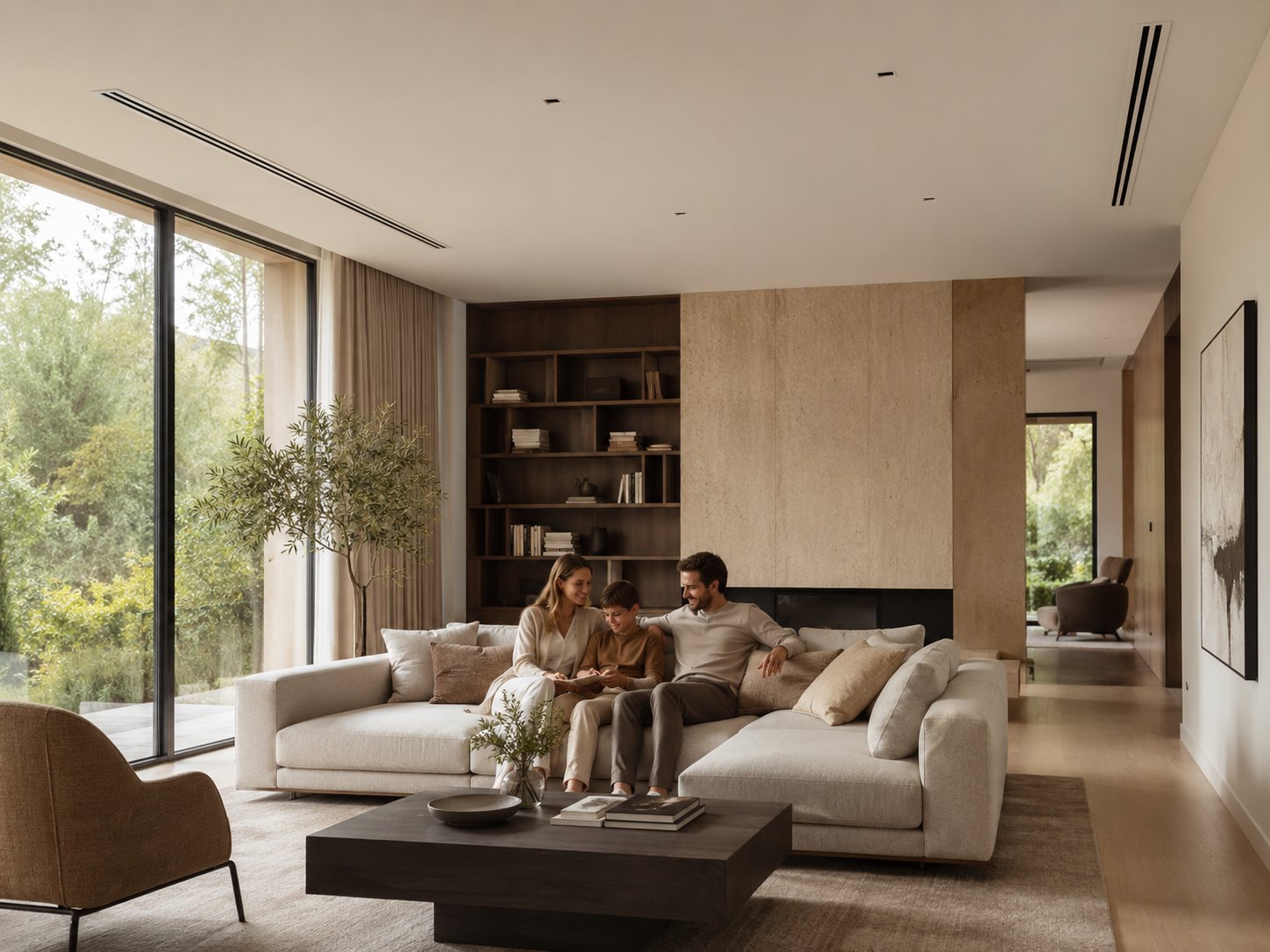
Just thirty years ago, most private homes could genuinely manage without a dedicated ventilation system. Timber windows had gaps. Doors were not airtight. External walls did not act like a thermos flask. Air constantly entered through leaks, whether the owner thought about it or not.
This was not good engineering. It was natural compensation for poor airtightness. The house lost heat, but gained fresh air at the same time. A modern private home is built very differently.
We have learnt to retain heat. But in doing so, we have stopped automatically replenishing the air.
A modern home cannot be airtight, energy-efficient and properly ventilated at the same time without carefully designed ventilation.
Airtightness has changed the rules
Modern windows are well sealed. External walls and roofs are insulated. Doors fit tightly. Heat losses have fallen, heating bills have become more manageable, and homes have become more technically advanced.
But in engineering, almost every effective solution has consequences. When we eliminated uncontrolled heat loss, we also eliminated the uncontrolled supply of fresh air.
Moisture, odours, carbon dioxide, household pollutants and emissions from kitchens, bathrooms, dressing rooms and plant rooms began to accumulate indoors. Homes became warmer, but not necessarily more comfortable.
An open window is not a system
When asked about ventilation, many homeowners give a simple answer: we open the windows. In some situations, this does help. But opening a window is a manual action, not an engineered system.
It does not work consistently at night. It does not work in winter without heat loss. It does not work during hot weather. It does not work when there is noise, dust, smoke or unpleasant odours outside. Above all, it does not provide even air exchange throughout the house.
One bedroom may receive fresh air while another remains stuffy until morning. Moisture may linger in the bathroom. Odours in the dressing room. Stagnant air in the plant room. A window addresses an immediate need, not the system as a whole.
People rarely complain specifically about ventilation
Interestingly, homeowners often do not describe the problem as ‘I have no ventilation’. They describe its consequences.
- Stuffy air in bedrooms in the morning
- Condensation appears on windows
- Moisture lingers in bathrooms
- Odours from the kitchen or bathrooms spread through the house
- Air feels stagnant in dressing rooms and storage rooms
- You want to open a window as soon as you wake up
- The temperature is right, but it still feels uncomfortable
Very often, this is neither a heating problem nor an air conditioning problem. It is an air exchange problem.
Home comfort is about more than temperature
In private homes, considerable attention goes to heating, underfloor heating, air conditioners, fireplaces, glazing and façades. But comfort cannot be reduced to the temperature on the thermostat.
Our experience of a home comes from a combination of factors: temperature, humidity, air quality, air movement, noise, odours and the stability of indoor conditions. If even one element is missing, a home can be expensive and beautiful yet still not particularly pleasant to live in.
That is why ventilation is no longer an ‘optional extra’. It is becoming a fundamental part of a home's indoor environment.
The biggest mistake is considering ventilation too late
Ventilation is often first discussed when the house is almost complete. The architecture, floors, ceilings, finishes, furniture and interior design are already in place. Then it suddenly becomes clear that space is needed for ductwork, an air handling unit, silencers, maintenance access, an outdoor air intake and an exhaust outlet.
At that point, a good solution becomes more difficult and expensive. Compromises are needed: lowering ceilings, concealing ducts in awkward places, accepting noise or relying on local solutions where an integrated system is required.
Ventilation for a private home should be designed alongside its architecture, not after the interior design.
Heat recovery is not a trend
Until recently, supply and extract ventilation with heat recovery was seen as a feature of very expensive homes. Today, the logic is different. If a home is well insulated and airtight, discharging warm air outdoors without recovering some of its energy becomes a questionable choice.
Heat recovery does not make ventilation free. But it provides fresh air without the sense that the owner is constantly throwing away heating or cooling they have paid for.
For a modern home, this is less a matter of prestige than of sound engineering logic.
Ventilation should be quiet
Ventilation in a private home has a particular requirement: it should not be audible. In an office building or shop, people often accept equipment noise as part of the environment. Not in their own bedroom.
Good ventilation therefore means more than correct air exchange. It means suitable duct air velocities, silencers, balancing, correctly positioned grilles, filter access and carefully configured controls.
Poor ventilation disrupts daily life. Good ventilation goes unnoticed.
A home has different zones with different patterns of use
A private home is not one large room. Bedrooms, children's rooms, kitchens, living rooms, dressing rooms, bathrooms, utility rooms, plant rooms, gyms and studies all serve different daily routines.
Some spaces need fresh air at night. Others need rapid moisture removal, odour control, quiet operation or stable temperatures. That is why ventilation for a private home cannot be reduced to ‘we will install a unit with this much airflow’.
You need to understand how the family lives, which rooms are used continuously and which occasionally, where priority is needed and where a basic operating mode is sufficient.
Invisible systems give a home its premium feel
Some things in a home are immediately visible: the façade, kitchen, flooring, furniture, lighting and sanitary fittings. Then there are the building services, which are barely visible. These often determine whether the home will still be pleasant to live in after one, three or ten years.
Ventilation does not create a wow factor in photographs. But it makes everyday life feel right. When breathing is easy in the bedrooms. When there is no excess humidity. When odours do not spread through the house. When there is no need to keep opening windows and dealing with the consequences.
This is not decorative comfort. It is everyday comfort that quickly becomes the norm.
Cutting costs on ventilation often has consequences later
During construction, ventilation can seem an easy place to save money. It is invisible. It is hard to show off to guests. It does not make the home look more luxurious.
But if the system is not planned in time, the owner pays in other ways later: discomfort, piecemeal alterations, noisy solutions, complicated remedial work, damaged ceilings or constant manual airing.
Engineering mistakes are particularly frustrating in a private home because the owner encounters them every day, not once a month.
Key takeaway
The question today is no longer whether ventilation is a luxury. That debate is long settled. A modern airtight home without controlled air exchange has an incomplete building services system.
Ventilation does not compete with heating or air conditioning. It works alongside them to create what people genuinely call comfort.
So the right question is not: does a private home need ventilation? It is: how can we design a home so that fresh air, quietness, energy efficiency and comfort work together from the first day people live in it?