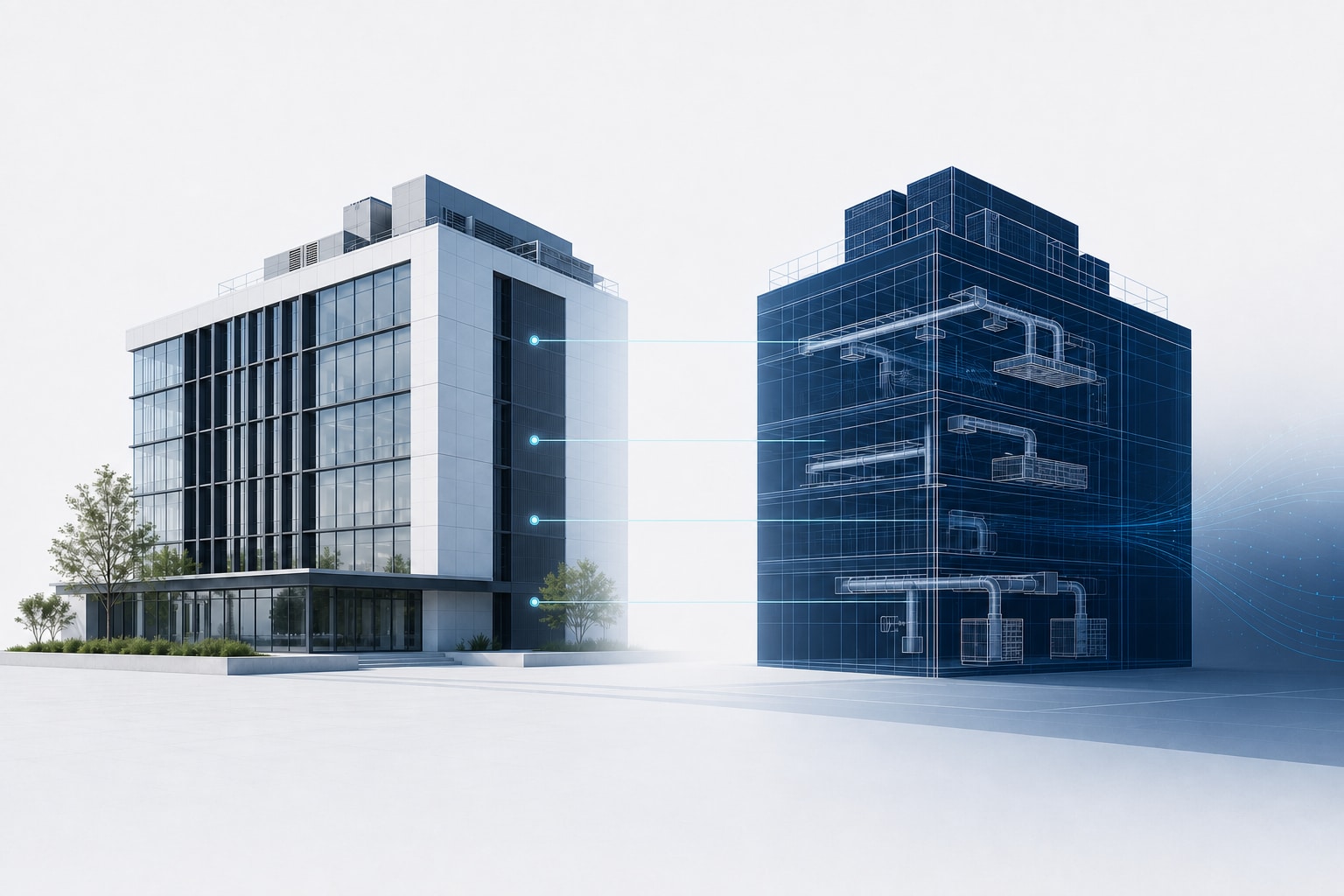
If marketing presentations are to be believed, artificial intelligence is almost ready to manage buildings on its own. It is expected to forecast loads, optimise energy consumption, allocate resources, detect faults and make better decisions than people.
It looks very convincing on slides. But real buildings do not exist on slides. They operate in a world of faulty sensors, human habits, tenant complaints, manual modes, old controls, incomplete documentation and decisions once made ‘temporarily’ that have remained in place for years.
That is why I do not believe in a swift, magical revolution in which AI suddenly replaces the engineer, the control room operator and the facilities team. But I firmly believe in something else: artificial intelligence can become a powerful tool for people who already understand building services engineering.
AI in building services is valuable not when it replaces the engineer, but when it helps the engineer see what previously remained invisible.
The biggest problem is not AI. It is the building
Many commercial properties already have controls, sensors, controllers, supervisory monitoring, meters and alarm logs. On paper, there seems to be enough data.
But a closer look reveals a different picture. Data may be fragmented, incomplete, unreliable or simply detached from its real meaning. There is a temperature reading, but it is unclear exactly where it is measured. There is an alarm, but no history of what preceded it. There are consumption figures, but they are not linked to tenant schedules, weather or system operating modes.
So the owner’s first question should not be: ‘Do we need AI?’ The first question is much simpler and more demanding: ‘Does our building have data we can trust?’
What works today
In my view, the most immediate practical benefit of AI in building services will not be autonomous control of an entire property. It will be supporting the people responsible for the building.
The most realistic applications today are:
- identifying deviations in equipment operation
- comparing actual system behaviour with normal behaviour
- analysing energy consumption trends
- detecting hidden faults early
- providing guidance to control room operators or service engineers
- preparing plain-language reports for the owner
This does not sound as impressive as ‘a building that controls everything itself’. But this is where real savings begin. Most losses in a building arise not from one major failure, but from thousands of small deviations that nobody noticed in time.
AI should look at behaviour, not just temperature
Conventional supervisory monitoring displays parameters: temperature, pressure, statuses, alarms, signals and charts. This matters, but it is no longer enough.
The next level is a system that starts to understand behaviour. Why one unit runs longer than the others. Why a particular zone constantly overheats. Why the ventilation does not slow down when the load has already fallen. Why electricity consumption at night is almost the same as during the day.
The real value of AI is not in displaying another chart. It is in asking the right engineering question.
This is where AI can be particularly powerful. It does not tire of reviewing historical data. It can compare hundreds of operating modes, identify recurring patterns, detect anomalies and highlight things that a person simply does not have time to check every day.
What will remain an impressive presentation
I am sceptical of promises of fully autonomous buildings in the near future. Not because the technology is weak, but because a building is not a laboratory model.
A real property has conflicting objectives. The owner wants lower costs. The tenant wants more comfort. The facilities team wants simplicity. The service team wants access to equipment. The finance team wants a predictable budget. Sometimes these objectives conflict.
AI can propose a solution. But it is not accountable to the tenant, the owner or the property management company. People will therefore remain part of the decision-making process for a long time.
The greatest potential lies in hidden losses
What matters to the owner is not how fashionable the term AI sounds. It is how much money the building will stop wasting.
In property, HVAC is often one of the largest energy consumers. But the problem is not just kilowatts. The problem is that excessive consumption very often does not look like a fault.
The system simply runs a little longer. A pump does not switch off in time. Ventilation maintains an excessive airflow rate. A compressor starts when another operating mode would have sufficed. One tenant complains, and the whole system starts performing worse for everyone else.
These are precisely the things AI can help identify. Not instead of the engineer, but alongside them. It can show where the building behaves differently from a properly functioning system.
AI needs a proper technical brief
Artificial intelligence cannot simply be ‘installed in a building’ like a new air conditioner. It needs a defined task: an engineering task, not a marketing one.
Not ‘make the building smart’, but something much more specific:
- identify excessive energy consumption
- detect unstable operating modes
- compare equivalent zones
- identify recurring faults
- assess which settings lead to complaints
- prepare engineering recommendations for operation
If the task is vague, AI becomes an expensive toy. If the task is clearly defined, it can become a tool for managing costs, comfort and equipment service life.
What owners should do today
I would not advise an owner to start by buying a ‘data-driven solution’. The starting point should be the building’s readiness for analytics.
You need to understand what data is already available, where it is stored, whether it can be trusted, who has access to it, whether historical system data exists, whether energy consumption is measured for key groups, and whether technical parameters can be linked to the facility’s actual operating conditions.
Only then does it make sense to discuss algorithms.
An AI-ready building is not a building with a fashionable label. It is a building whose data, controls and operations are ready to work together.
The future will be pragmatic
I believe that in the coming years we will see engineers’ work change rather than engineers being replaced. Less manual review of disorganised parameters. More analysis of deviations. Less reaction after a failure. More early warnings. Less intuition without data. More tested hypotheses.
The winners will not be the companies that buy AI first. They will be those that successfully combine engineering expertise, quality data, accountability and digital tools.
Key takeaway
Today, the market often asks the wrong question: will AI replace the engineer?
In my view, the right question is different: which engineers and owners will be the first to learn how to use AI to monitor a building’s actual performance?
Because artificial intelligence will not turn weak engineering into strong engineering on its own. It will simply expose its weaknesses faster.
AI does not remove the need for engineering judgement. It raises the cost of its absence.
How to define a verifiable task for AI
It makes sense to limit an initial pilot to a single problem: for example, explaining why ventilation runs outside the agreed schedule. This task requires:
- Unit commands and actual operating states, the operating schedule and a history of manual changes.
- Timestamps, clear signal names and flagged data gaps.
- An engineer’s assessment of whether the deviation was unnecessary operation or a justified facility requirement.
- An agreed procedure defining who approves the recommendation, changes the operating mode and checks the outcome.
A useful pilot outcome is a confirmed cause and a verified action. If data is insufficient, the outcome should be a precise list of gaps. The division of work between engineering, integration and analytics is described in ‘At the intersection of HVAC, IT and artificial intelligence’.