
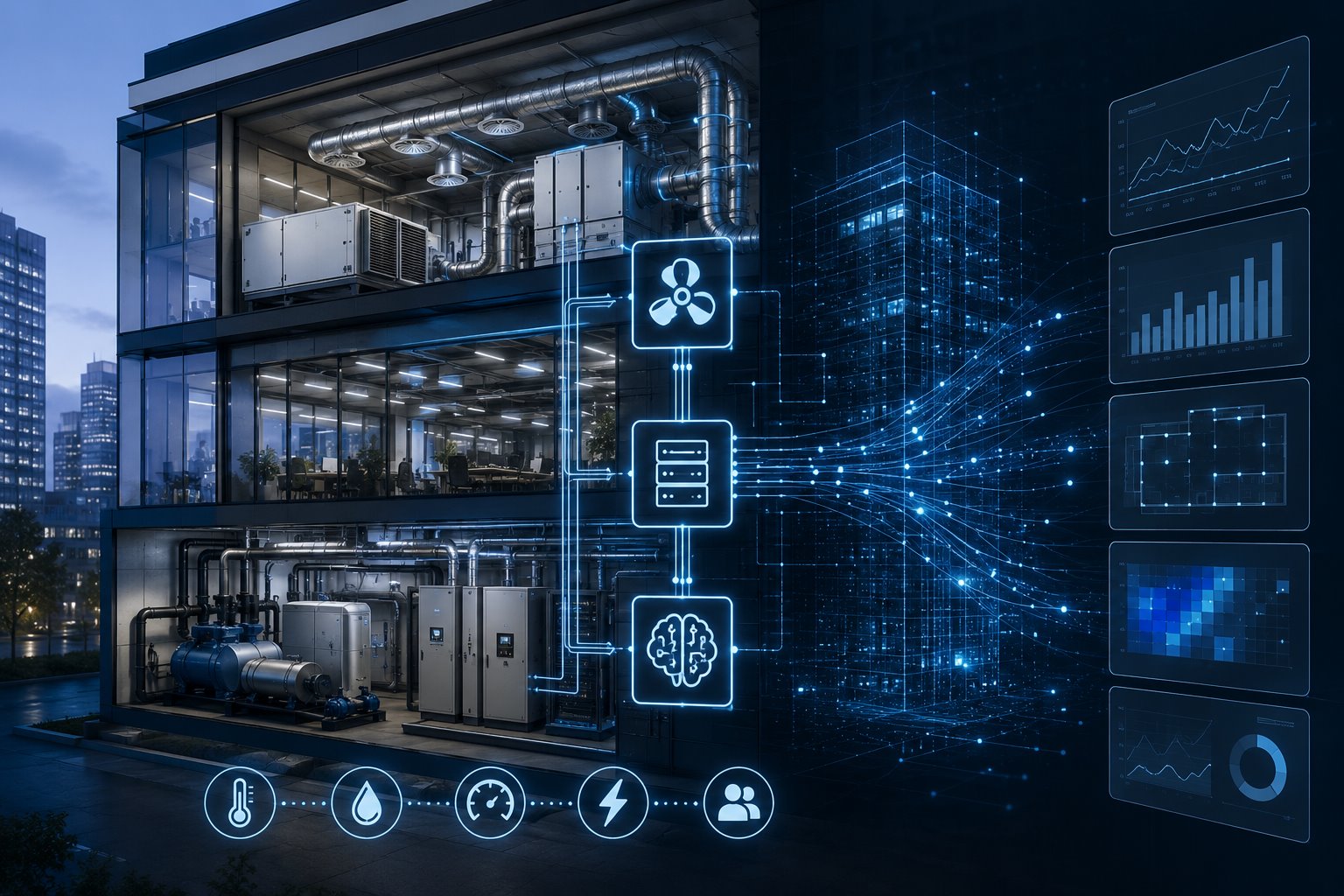
I have spent most of my career in building services engineering. Air conditioning. Ventilation. Heating. Controls. For a long time, HVAC was a fairly self-contained field: we designed systems, installed them, commissioned them and maintained them.
It seemed that the main changes were happening within engineering itself. New compressors. New fans. New heat exchangers. New heat recovery units. Greater efficiency. Lower noise. Better catalogues.
But over the past few years, I have increasingly seen a different picture. The most interesting changes no longer originate solely within HVAC. They emerge at the intersection of three worlds: engineering, IT and artificial intelligence.
The future of HVAC is no longer just about equipment. It is about a building’s ability to understand its own operation.
The equipment has become good enough
Modern HVAC systems have genuinely reached a high standard. VRF, chillers, heat pumps, heat recovery units, controls and variable-speed drives have long ceased to be unusual in buildings.
In many cases, a building’s problem is not that it cannot cool, heat or ventilate a room. The problem is that it does not always do so at the right time, in the right place or at the optimum cost.
That is why simply upgrading equipment no longer always delivers the expected result. A new compressor, heat recovery unit or controller may be a good solution. But these do not answer the main question: does the building understand what is happening to it?
The building is becoming a digital system
A modern office building, shopping centre, hotel or industrial facility generates a vast amount of information every day. Temperatures. Pressures. Airflow rates. Equipment operating modes. Electricity consumption. Faults. User complaints. Tenant schedules. Weather conditions.
Previously, most of this information simply disappeared. The operator saw the current status. The service engineer came to deal with a problem. The owner saw the energy bill. But the building did not accumulate knowledge about itself.
Now everything is changing. Servers, databases, cloud services, APIs, analytics and cyber security are becoming just as important to a building services system as a pump, valve or air handling unit.
A building is gradually ceasing to be merely a collection of building services equipment. It is becoming an information system with a physical body.
AI does not replace the engineer
There is a great deal of unnecessary hype around artificial intelligence. It is often imagined as a system that controls all equipment itself and replaces people. I think the reality in the near future will be different.
AI will not replace an engineer who understands the building. But it can become a new tool for them. One as important as supervisory control, variable frequency drives or digital controllers once became.
Its value is not in magic. Its value lies in its ability to identify patterns where a person sees only a stream of events. It can detect anomalies, compare operating modes, uncover hidden losses, suggest priorities and warn of problems before they become failures.
Older buildings can become smarter too
There is an important point that is often underestimated. A building's digital development does not always require all its equipment to be replaced. Many facilities already have perfectly adequate chillers, VRF systems, ventilation and controls. What they lack is something else: a higher layer of logic.
Additional telemetry, a proper data history, suitable algorithms, analytics, integration with supervisory control and clear decision-making rules can substantially improve the performance of even an older building services system.
In other words, replacing equipment is not the only way to make a building smarter. Sometimes it is enough to teach it to make better use of what is already installed.
A new question for investors
Previously, clients often asked: which equipment brand is better, how efficient is the heat recovery unit, what is the COP, what is the noise level, and how much does installation cost? All these questions remain important. But they are no longer enough.
Now we need to ask different questions. Are the protocols open? Is the operating history retained? Can data be retrieved from the equipment? Can the systems integrate with one another? In three years' time, will the operations team be able to understand what happened in the building last season?
Because these are the answers that determine whether a facility is ready for the next stage of HVAC development.
The key question is no longer simply which equipment to install. The key question is whether the building will be able to work with data.
A new profession emerges at the intersection
I believe that, over the coming years, the market will see more people with an equally strong understanding of engineering, automation, data and a building's business logic. Not just designers. Not just programmers. Not just service engineers. But specialists who see the facility as a single system.
They will be the ones explaining to owners why air conditioning is not just about temperature, ventilation is not just about air exchange, and supervisory control is not just an attractive display on a monitor.
HVAC remains a physical engineering discipline. Air, water, refrigerant, electricity and heat are not going away. But the main added value is gradually moving to a higher level: data, logic, integration and the ability to make better decisions.
That is precisely why the industry's future is not taking shape within a single discipline. It is taking shape at the intersection of HVAC, IT and artificial intelligence.
What engineers and integrators need to share
To give the numbers engineering meaning, it is worth preparing an agreed data map for the first system:
- Signal: name, unit of measurement, equipment and actual sensor location.
- Time: polling interval, time zone, available history and known gaps.
- Meaning: what statuses and alarms mean, which operating modes are normal and what changes have already been made.
- Access: which data can be read, who has write permissions and who approves changes.
The engineer explains the physics and constraints, the integrator checks data transmission and storage, and the analyst tests hypotheses together with the operations team. Agreed decisions and subsequent changes should be added to the digital system record.