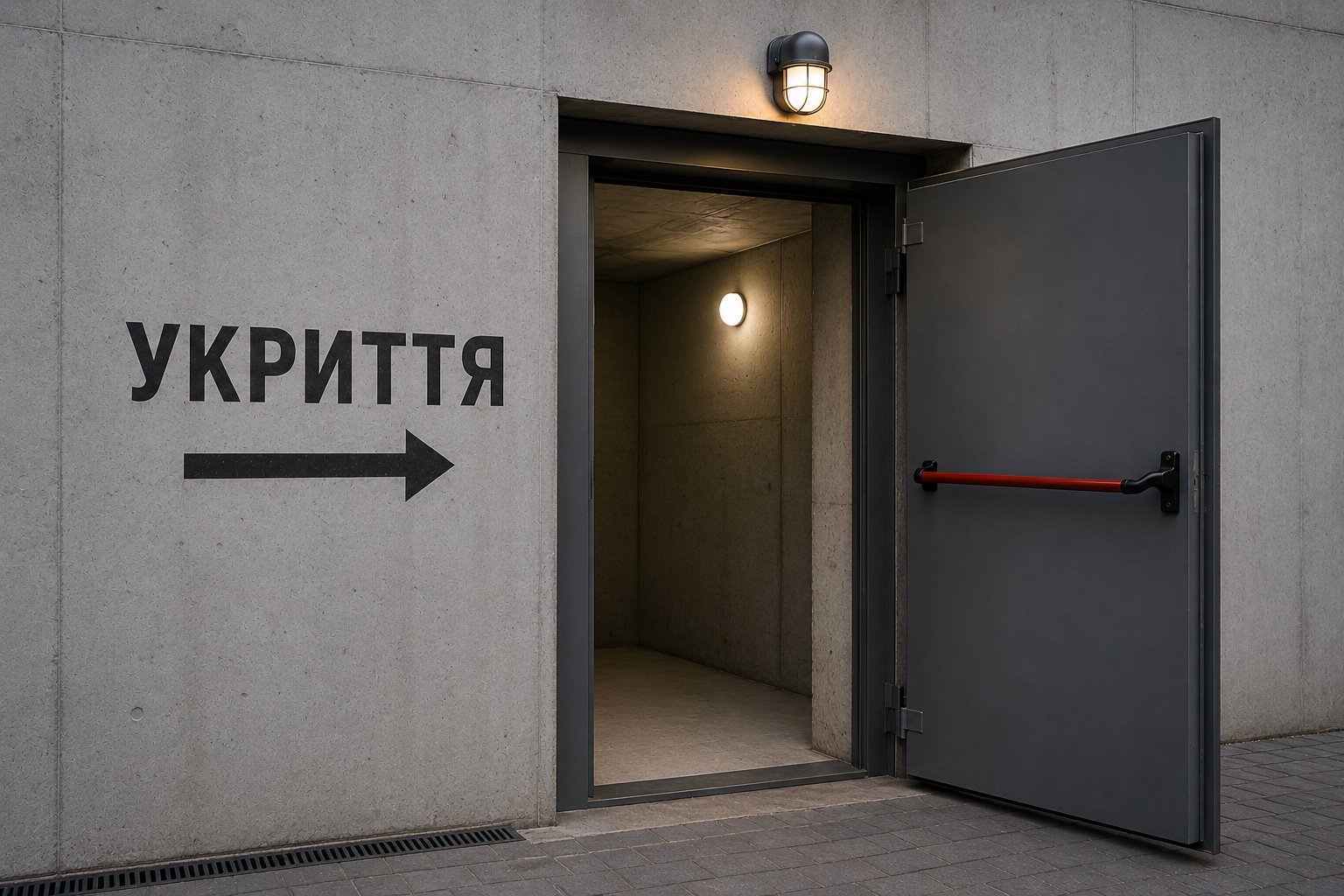
When we talk about shelters, most people still picture concrete. Thick walls, heavy doors, strong floor slabs and a sign at the entrance. That is understandable. A protective structure starts with its structural design.
But in my view, something much deeper is happening in Ukraine today. A shelter is gradually becoming more than just a structural element. It is becoming a distinct engineered environment where not only walls matter, but also air, self-sufficiency, controllability, maintenance, use scenarios and responsibility for the outcome.
In effect, a new engineering sector is emerging in Ukraine. And many have yet to notice, because they are used to seeing a shelter as a basement with reinforced doors.
A modern shelter is not simply a place people can enter. It is a system that must work precisely when the cost of error is highest.
Concrete alone is no longer enough
Structural strength remains the foundation. Without it, there is no point discussing anything else. But once people are inside, a different kind of engineering begins.
Air exchange must be provided. We need to understand what is happening with temperature, humidity, carbon dioxide levels, noise, power supply, sanitary conditions, equipment access, maintainability and operating modes.
In an ordinary building, discomfort is often seen as an operational issue. In a shelter, it very quickly becomes a matter of safety, resilience and people's ability to remain inside for as long as necessary.
This is no longer a temporary concern
A few years ago, many private clients saw protective structures as something separate, almost exotic: state facilities, specialist enterprises, old regulations and isolated projects.
Today, the situation is different. Schools, hospitals, residential developments, business centres, manufacturing facilities, logistics facilities and retail premises increasingly face the need for a shelter that genuinely works, rather than merely exists on paper.
It is important to recognise the scale of this change. We are no longer talking about a few unusual projects. We are talking about a new market, a new area of expertise and a new layer of responsibility for engineers, designers, manufacturers, contractors and property owners.
Installing equipment is not the hardest part
In any new sector, there is a temptation to reduce everything to equipment. Select a unit, dampers, filters, fans, controls, cables and electrical panels. It seems that if the specification contains the right items, the problem is solved.
But in shelters, the key question is not just what is installed. It is how everything works as a system.
Are the operating modes clear? Can the operations team use them? Is there access for maintenance? Will a complex solution become merely decorative within a year? Is functionality tested? Does the owner understand exactly what must be kept in working order?
A shelter must not be designed as a room that simply needs to pass an inspection. It must be designed as a system that will one day have to be used for real.
Ukraine is not simply copying others' experience
In many engineering disciplines, we are used to catching up. VRF came from Japan. BMS developed rapidly in Europe and the USA. Energy efficiency was shaped by Western standards for many years.
With shelters, the situation is more complex and more interesting. Of course, we study others' experience. We examine Israeli approaches, rethink old Soviet solutions and analyse modern European practices.
But the scale of the challenges facing Ukraine today is highly specific. We do not need museum-piece schemes or ideal solutions from presentations. We need systems that can be designed, manufactured, installed, tested and maintained at scale, and explained to the people who will use them.
Manufacturers have already recognised the new market
One of the most interesting signs of a sector taking shape is manufacturers' behaviour. When shelter equipment appears not as a one-off catalogue item but as a dedicated product area, it means the market is entering a new phase.
Specialist filtration and ventilation units, airtight dampers and dedicated solutions for ductwork, controls, redundancy and system condition monitoring are emerging. Manufacturers are beginning to think not only about selling a fan, but about creating a product for a specific safety scenario.
This is how all specialist engineering markets develop. First comes a problem. Then individual solutions. Then practical experience. Then standards, products, installation practices, maintenance services and a professional language of their own.
Experience is the most valuable resource now
It seems to me that the main value at this stage is being created not only in factories or design organisations. It is being created at the intersection of design, installation, testing, operation and mistakes.
Some already understand where maintenance space is insufficient. Some see which solutions look good on a drawing but perform poorly on site. Some discover that a complex system cannot be properly explained to staff. Others are beginning to take a fresh look at backup power, controls, access, noise and ease of operation.
All of this is gradually forming a school of practice. Not a theoretical one, but a highly practical one: a Ukrainian school of protective structure engineering.
This is an important change for owners too
Commercial property owners need to understand that a shelter is not simply a requirement to be dealt with somehow. It is part of a building's value, its reputation, tenant confidence, staff safety and business resilience.
Like any engineered system, it can be a box-ticking exercise. Or it can be well thought out. It can exist only in documents. Or it can genuinely work. It can create operational problems. Or it can be an understandable, tested and controllable part of the building.
That is why the question should not simply be: does the property have a shelter? A much more important question is: can it fulfil its function in a real scenario?
Key takeaway
I am almost certain that, in a few years, ventilation for protective structures will be viewed in the same way as engineering for data centres, cleanrooms or healthcare facilities is today: as a distinct, highly specialised sector with its own principles, equipment, mistakes, experience and professional responsibility.
And perhaps Ukrainian engineers will be among those shaping its future standards. Not because we set out to create a new market, but because reality presented us with challenges for which ready-made answers proved insufficient.
New engineering schools emerge not when new equipment appears, but when life forces engineers to take responsibility for a new reality.