There is a debate in the property sector that has continued for decades: VRF or chiller, refrigerant or water, decentralised or centralised systems.
At first glance, this is a technical question. But for a retail chain, it very quickly becomes a business question. The chain owner does not make money from VRF systems or chillers. They make money from shops that need to open quickly, operate reliably and be easy to maintain.
For a single shop, you can spend a long time searching for the ideal system. For a chain, it is more important to find a solution that can be replicated dozens of times without losing control.
A chain is not buying equipment. It is buying a growth model
Imagine a simple situation. A chain has fifty shops. Another ten or fifteen new sites open each year. Some premises are leased. Some have restrictions relating to the façade, roof, electrical capacity or construction schedule.
At this point, the owner is asked to choose between two systems as though the decision concerned a single site. One contractor argues that VRF is the best solution. Another makes the case for a chiller. Each presents tables, charts, efficiency ratios and impressive calculations.
But very often, almost nobody asks the key question: what business model must this building services system support?
Opening quickly sometimes matters more than perfect efficiency
For a chain business, a shop’s opening date often carries more weight than a few percentage points of energy efficiency. A shop earns nothing while it is closed. It delivers no return on investment while approvals, installation, rework or the search for bespoke solutions continue.
So the question is not which system is most efficient in a laboratory comparison. A better question is which system allows shops to open faster and more predictably, with fewer risks for the operations team.
The most expensive system for a chain is not always the one with the highest price tag. Sometimes it is the one that holds back growth.
Tenders often focus on the wrong costs
In a tender, it is easy to compare equipment costs. It is easy to compare installation costs. It is easy to put two figures side by side and choose the cheaper option. But a chain business loses or makes money on more than just the initial price.
The real economics lie in other questions:
- how long it takes to open a new shop;
- whether the solution can be replicated across different locations;
- whether service support is available in the required cities;
- how quickly spare parts can be obtained;
- whether local operations teams understand the system;
- what happens to the shop if a breakdown occurs;
- whether every new site becomes a separate engineering experiment.
These factors often cost a chain more than the difference between two quotations.
An ideal system can be a poor fit for a chain
This is an unpopular view, but a technically strong solution is not always right for the business. A system can have good specifications, sound logic and quality equipment, yet still be poorly suited to a particular chain.
For example, if each site requires a bespoke design, scarce specialists, complex servicing and long component lead times, the system may look impressive in a presentation but create problems when scaling up.
For a chain, the quality of an individual solution is not all that matters. Its repeatability matters too.
Standardisation has financial value too
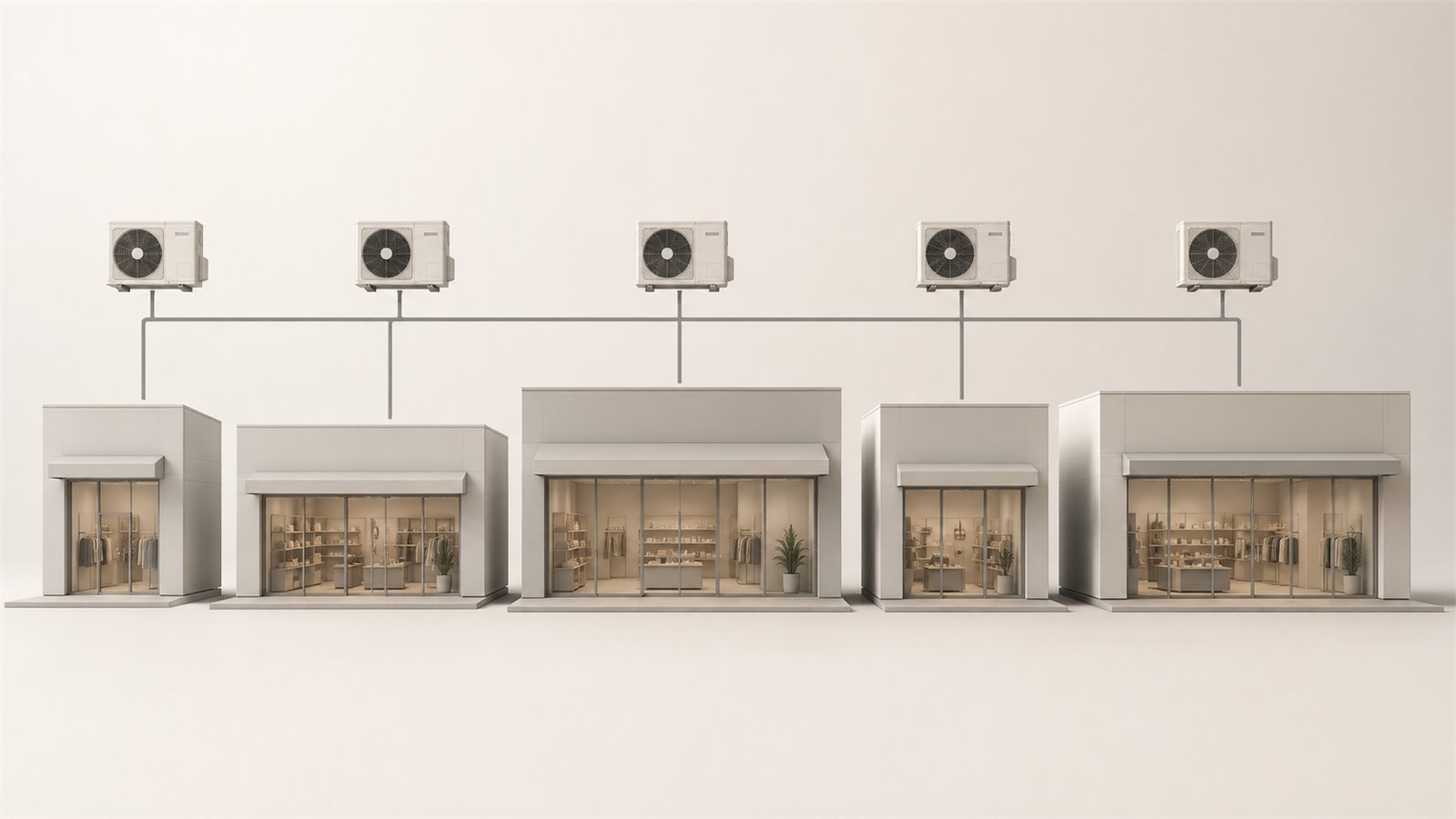
In mature chains, building services systems should be part of the standard process for opening a shop. Not a new philosophy, a new contractor, new schematics, new settings and new exceptions every time, but a clear set of solutions for standard store formats.
Standardisation offers very practical advantages:
- faster design;
- simpler approvals;
- clearer procurement;
- easier staff training;
- fewer installation errors;
- simpler operation;
- clearly defined spare parts stock.
A standardised solution may sometimes seem less than ideal for an individual shop. But for a chain with dozens of sites, it can offer significantly better value.
Service is part of the system, not an after-sales add-on
For an individual site, service is often mentioned at the end. For a chain, it needs to be discussed at the outset. A breakdown in one shop is not just a technical problem. It means lost sales, customer discomfort, pressure on staff and reputational risk.
If the equipment is good but reliable service support is unavailable in a particular city, the chain gains a vulnerability rather than an advantage. If spare parts take weeks to arrive, the true cost of the solution changes. If the local team does not understand the system, its complexity starts working against the owner.
Choosing a system for a retail chain therefore always means choosing not just equipment, but a service model too.
The right question is different
I believe chain owners should start less often with ‘VRF or chiller?’ and more often with other questions.
- What will our chain look like in five years?
- How many shops do we plan to open each year?
- In which cities do we need service support?
- How much shop downtime would be critical for us?
- Who will operate the system after opening?
- Which solution can we replicate without chaos?
Only then does it make sense to discuss a specific technology.
A retail chain is not buying an air conditioning system. It is buying the ability to open quickly, operate reliably and retain control as it scales.
That is why the best system for a chain is not the one that wins an abstract technical debate. It is the one that best fits the business’s actual growth strategy.