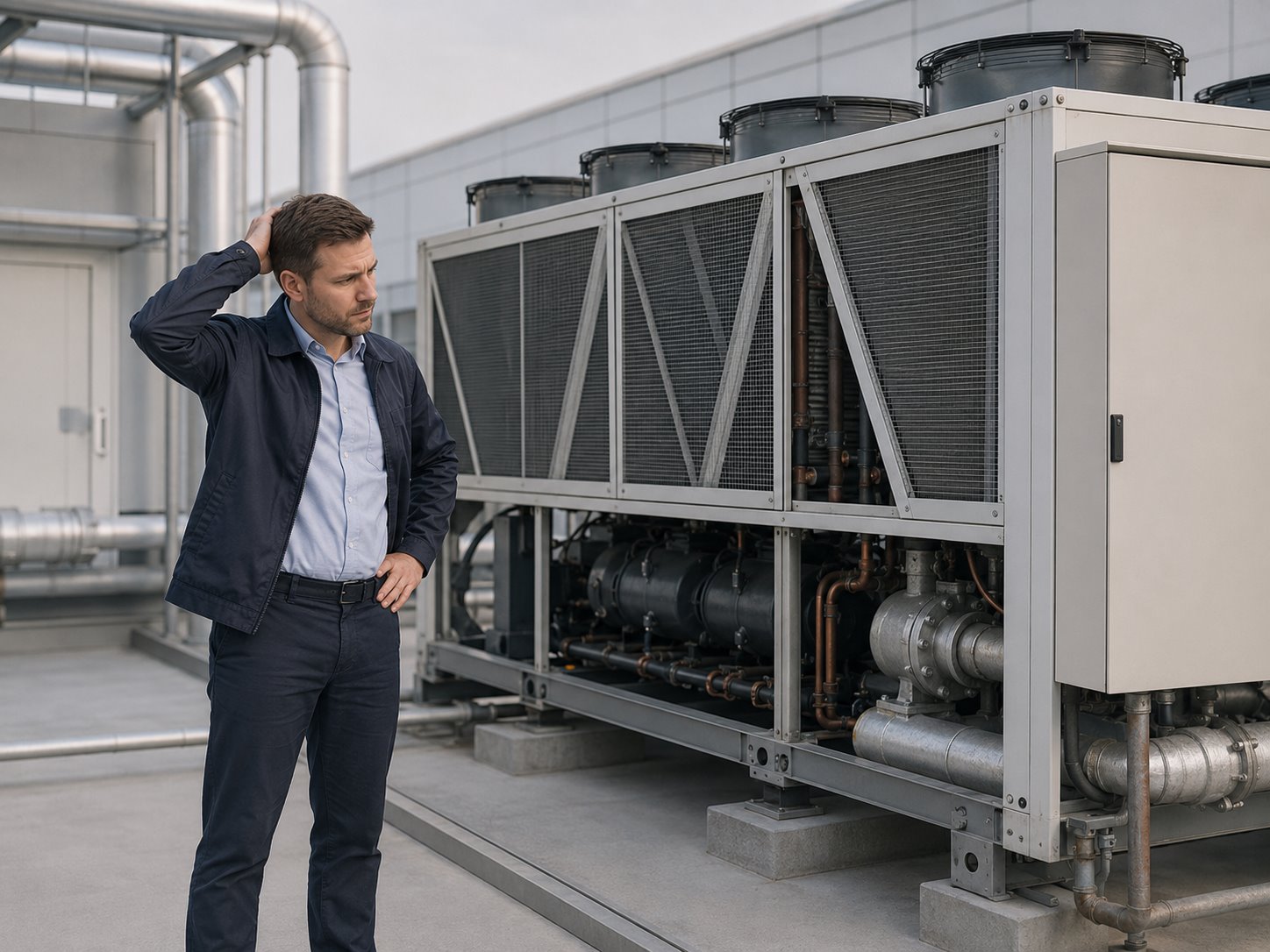
There is a question I ask myself at almost every commercial property. Who is really keeping track of the owner’s money?
At first glance, the answer is obvious. The finance director, accounts department, financial analyst or site manager. They see budgets, payments, invoices, contracts and cash flow shortfalls.
But in property, a significant share of the money is not spent in the finance department. Every day, it flows through ventilation, air conditioning, heating, controls, servicing and the building’s operating settings.
And if these systems operate without oversight, the owner may spend years paying not for comfort and reliability, but for the building’s habit of muddling along.
A building can keep running while losing money
That is the central problem. Waste in building services systems rarely looks like a catastrophe.
The shopping centre is open. The restaurant is welcoming guests. The office is operating. The fitness club has not shut down. The hotel has heating, cooling, ventilation and hot water. At first glance, everything looks normal.
But normal building operation does not necessarily mean cost-effective operation. Equipment may start, people may not complain every day, and the controls may show no alarms, while OPEX remains higher than it should be.
The most dangerous losses are not those that immediately bring a property to a halt. They are the ones that let the building keep running while draining the owner’s money every month.
Engineering is not separate from finance
For a long time, HVAC was treated as the technical side of a building. There are air conditioning units, ventilation, a boiler plant or heat substation, and controls. The task is simple: keep it working.
But for a commercial property owner, that is far too weak a criterion. Building services affect more than air temperature. They affect operating costs, tenant complaints, business downtime, equipment life, peak loads, servicing costs and budget predictability.
That is why HVAC is not just about comfort. It is part of a building’s economics. And if it is not managed, the money is only counted after it has been spent.
Where the money goes
In day-to-day operation, money rarely disappears through one major decision. More often, it drains away through minor operating routines that nobody has reviewed for years.
Ventilation runs longer than necessary. Pumps circulate water according to outdated control logic. Air conditioning units battle both overheating and incorrect settings. Operating schedules do not match actual building occupancy. Controls are installed, but used as a collection of manual switches.
Each individual instance may not look critical. But over a building’s life cycle, these things shape the cost of ownership.
Money is not always lost through a breakdown. Very often, it is lost through an operating mode that looks normal but is wrong.
Facilities teams see operation, but not always the economics
I do not believe the facilities team is always the problem. Often, they are simply given different priorities: prevent breakdowns, ensure equipment starts, avoid tenant complaints and keep unnecessary problems away from management.
That logic is understandable. But there is a substantial gap between ‘no breakdown’ and ‘the system is operating cost-effectively’.
The facilities team may see a temperature, pressure, alarm or tenant request. But they do not always see how much that particular operating mode costs, or whether the property actually needs it.
For the owner, this means one simple thing: a building can be technically sound but financially uncontrolled.
The most important work begins after installation
The market scrutinises spending very carefully before purchase. Brands are compared, tenders held, prices negotiated down, specifications checked and every assembly debated.
But once the property is operational, oversight often weakens. The equipment is installed, acceptance documents are signed, the system works — and the building moves into day-to-day operation.
This is where the real economics begin. The purchase price matters once, while operating modes, energy costs, servicing, comfort and reliability affect the owner every day.
Equipment should not be judged solely by its initial cost. It should be judged by the results it delivers in operation.
The mistake of choosing on price alone
One common mistake is to treat an engineering solution as an equipment purchase. The quoted price then becomes the main criterion, while everything else seems secondary.
But a commercial property does not operate in a tender spreadsheet. It operates through seasons, peak loads, tenant changes, night-time modes, service visits, complaints, tariffs and responsibilities to the business.
A cheap system may prove expensive to operate. An expensive system may fail to deliver the expected results if it has been incorrectly designed, installed or commissioned. A brand can reduce risks, but it cannot replace sound building operating logic.
For the owner, what matters is not the equipment name itself, but a controllable outcome: comfort, stability, clear costs and the ability to influence what happens in the building.
Who should be tracking these costs?
The finance director sees the bill. The accounts team sees the payment. The owner sees the total. But the reason behind that total often lies in the building services.
A well-managed commercial property therefore needs more than cost accounting: it needs a technical explanation of those costs. Not just ‘how much did we consume?’, but why that amount was consumed. Not just ‘how much did we pay?’, but whether the same result could have been achieved more intelligently.
This does not always require new equipment. Often, reviewing the operating logic, schedules, settings, telemetry, system interactions and responsibility for the outcome is enough.
A new criterion for building quality
A modern commercial building is no longer judged solely by its façade, location, fit-out and tenant brands. How effectively it can be managed is becoming increasingly important.
Is it clear what is happening with energy consumption? Are peak loads visible? Can operating modes be changed quickly without disruption? Is comfort under control? Can OPEX be explained through the actual operating logic of the systems rather than generalities?
A building that is under control offers its owner more than lower costs. It offers peace of mind, predictability and greater asset liquidity. Buyers, tenants and investors increasingly look beyond floor area to what that space costs to operate every day.
The question that puts you in control
The future of building operation does not necessarily begin with buying a new chiller, a new BMS or the latest fashionable automation system. Very often, it begins with a simpler, more honest question.
Who is tracking your money today?
And are you sure that person is looking not only at the energy bills, but also at the reasons behind them?
Mature engineering is not about ‘it works, somehow’. It is about ‘we understand what is happening in the building, what it costs and how to manage it’. That is where real control over a building begins.