
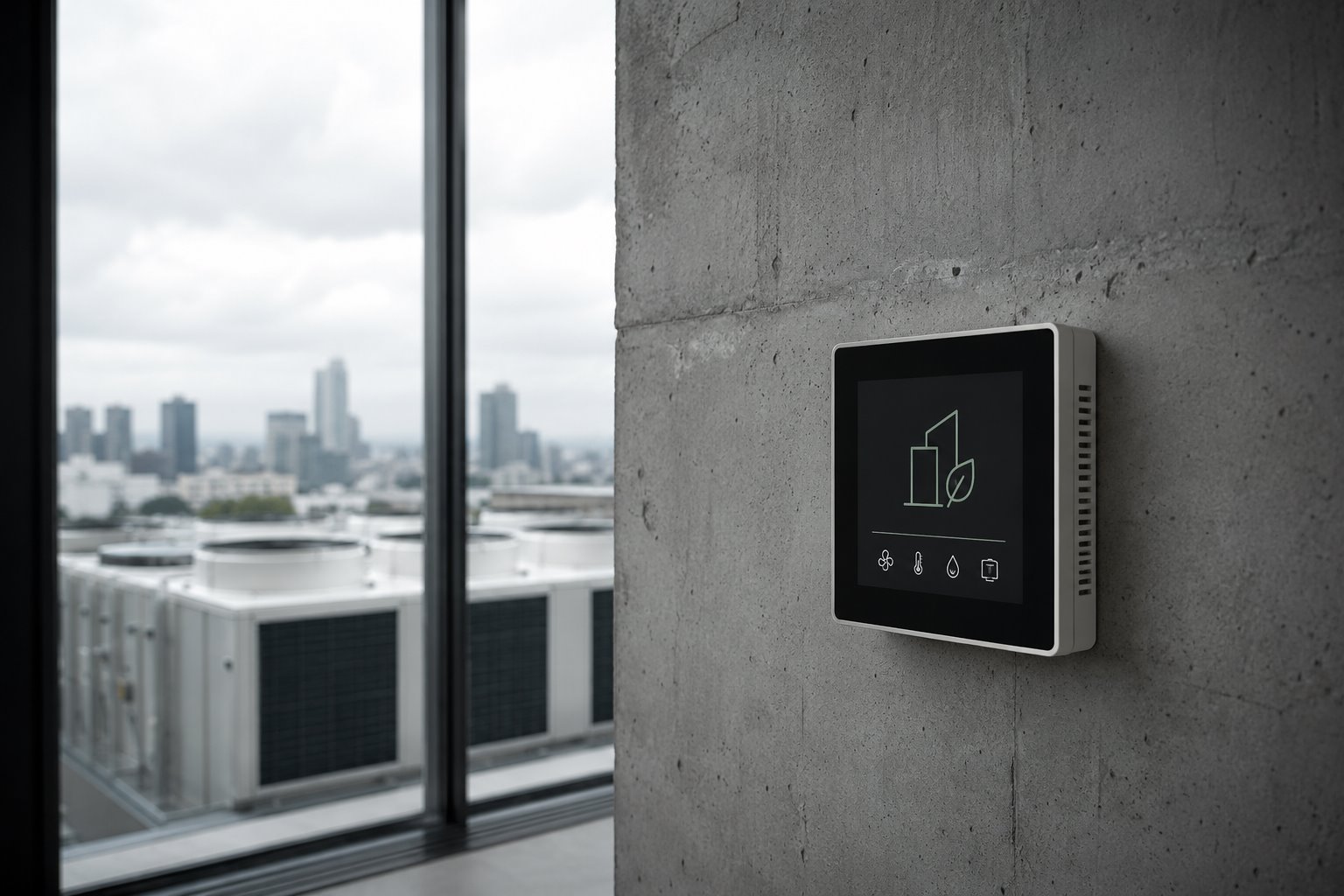
For the past twenty years, the engineering market has been waiting for the next technological breakthrough. A new compressor. A new heat recovery unit. A new VRF system. A new heat pump. A new controller.
And each time, it seemed that new equipment would radically improve building efficiency. But today, I increasingly find myself thinking differently. Perhaps the next major revolution in building services will not come from within HVAC.
The biggest change of the next decade will not be how a building cools or heats air. It will be how it makes energy decisions.
Modern equipment is already very good
It is hard to find a modern fan that is fundamentally poor. It is hard to find a modern compressor that cannot operate efficiently. It is hard to find a heat pump or heat recovery unit that has not undergone extensive technical refinement.
Of course, differences exist between brands, equipment classes and the quality of engineering solutions. They matter. But the market has moved beyond the stage of stark technological disparities, when one machine looked like the future and another like the past.
We are approaching the point where each additional percentage point of rated efficiency costs more and more. That is precisely why the greatest scope for improvement is beginning to shift elsewhere.
Buildings do not lose money because of poor compressors
There is a paradox here. Equipment has improved, controls have become more sophisticated and there are more sensors, yet many buildings still operate far below their potential.
The cause almost never lies solely in the compressor, heat exchanger or fan. Often, the problem lies between systems. In how they interact. How they respond to changing loads. How they account for the weather, tenants, tariffs, solar generation, energy storage, operating schedules and the building’s actual behaviour.
Old control logic no longer fits the new reality
Most buildings still think in very simple terms. The temperature rises — cool. The temperature falls — heat. People are present — ventilation runs. No one is there — switch it off.
For some facilities, that really is enough. But a commercial building is gradually becoming a much more complex system. It no longer merely consumes electricity and maintains temperature.
A single site may simultaneously operate a solar power installation, an energy storage system, a heat pump, charging stations, ventilation, air conditioning, lighting, supervisory controls and an energy metering system.
If all these elements operate independently, the building is technically modern but its management is outdated.
The next revolution will come from the energy sector
I believe the energy sector will force HVAC to change faster than HVAC could change from within.
A building is no longer a passive consumer. It can generate energy, store it, shift loads, avoid peaks, choose when equipment runs and manage comfort with energy costs in mind.
This is an entirely different role. Owners no longer see building services merely as a cost. They begin to see them as a tool for managing the economics of the site’s energy use.
When a building has generation, storage and flexible demand, HVAC becomes part of its energy strategy, rather than simply a comfort system.
The difference will not lie in a single unit
Imagine two identical office complexes. One has a heat recovery unit with higher rated efficiency. The other has a slightly simpler one. There is a difference, and it can be calculated.
Now imagine a different distinction. One building takes account of the weather forecast, future load, tenant occupancy, energy storage status, its own generation, electricity tariffs and the thermal inertia of its structure. The other operates with static settings.
Here, the difference can be much greater than between two good units. Because the first building makes decisions. The second merely follows commands.
AI will become part of control, not a passing trend
Artificial intelligence matters in this context, but not as a magic button. I do not believe in a scenario where AI simply replaces the engineer and independently controls a complex building without professional accountability.
But I can clearly see another scenario. AI analyses operating history, identifies deviations, detects trends, compares operating modes, helps uncover hidden losses and suggests better courses of action to the operations team.
In other words, it becomes not a replacement for engineering, but a new analytical layer above it.
We will buy not equipment, but the ability of systems to work together
Today, a client often buys a chiller, an air handling unit (AHU), a heat pump, controls, a pump set and supervisory controls. Each discipline separately, each budget separately, each area of responsibility separately.
But future value will not lie in the list of equipment purchased. It will lie in whether these systems can work as a single organism.
Key takeaway
I do not think the main innovation of the next decade will emerge from HVAC alone. It will most likely emerge at the intersection of energy, automation, energy storage, analytics, AI and building management.
HVAC will remain a critical part of the building. But its role will change. It will cease to be an isolated building services system and become part of a broader energy control strategy.
And then the most valuable element will not be an individual compressor, an individual heat recovery unit or even an individual heat pump. It will be the building’s ability to make the right decisions.
The future of building services is not simply about delivering cooling, heating or air. It is about managing the building as a single intelligent energy system.
What to coordinate between HVAC and energy systems
Before introducing control based on tariffs, generation or forecasts, common rules are needed for systems that previously operated independently:
- Permissible temperature limits and schedules that must not be compromised to achieve savings.
- Data sources for consumption, generation, energy storage status and available capacity.
- Command priority: which system is in control, how protective functions operate and who can change settings.
- A fallback mode that reverts to the baseline control algorithm if communication is lost or data is unreliable.
Start with an agreed scenario and a comparison against baseline operation. Verification of data and recommendations is discussed in the article on practical AI tasks for building services.