Imagine this situation. An owner buys a business centre, shopping centre, hotel or industrial facility. It is a major transaction involving substantial sums, and a decision with long-term implications.
They then receive design documentation, as-built drawings, equipment technical records, completion certificates, instructions, schematics, warranty letters and dozens of technical files. On paper, there is plenty of information. Sometimes even too much.
But at some point, an uncomfortable fact emerges: the owner has documents about the building, but no clear understanding of how it actually operates today.
A commercial building can have hundreds of technical documents and still have no engineering memory of its own.
Documents do not equal knowledge
The design shows how the building was intended to be built. As-built drawings show what was installed at a particular point in time. Equipment technical records describe individual units. Completion certificates confirm the work carried out.
But none of this answers the owner's main question: what is actually happening in the building right now?
Over a few years, tenants, operating modes, settings, schedules, controls, maintenance approaches, individual components and even the way spaces are used all change. Some decisions are made during construction. Others during operation. Others during emergencies, refurbishments or urgent tenant relocations.
And very often, this history is not properly recorded anywhere.
The most valuable knowledge often lives in one person's head
Many buildings have someone who “knows everything”: a chief engineer, an experienced technician, a service engineer or a representative of the company that has maintained the building for years.
They remember why a system was reconfigured. Why a particular circuit does not operate as designed. Where spare capacity was retained. Why one valve is always open. Which solution was temporary but remained in place for years.
The problem is that, for the owner, this is a very fragile form of capital. The person may resign. The service company may change. The management team may leave. And with them, the building loses part of its own memory.
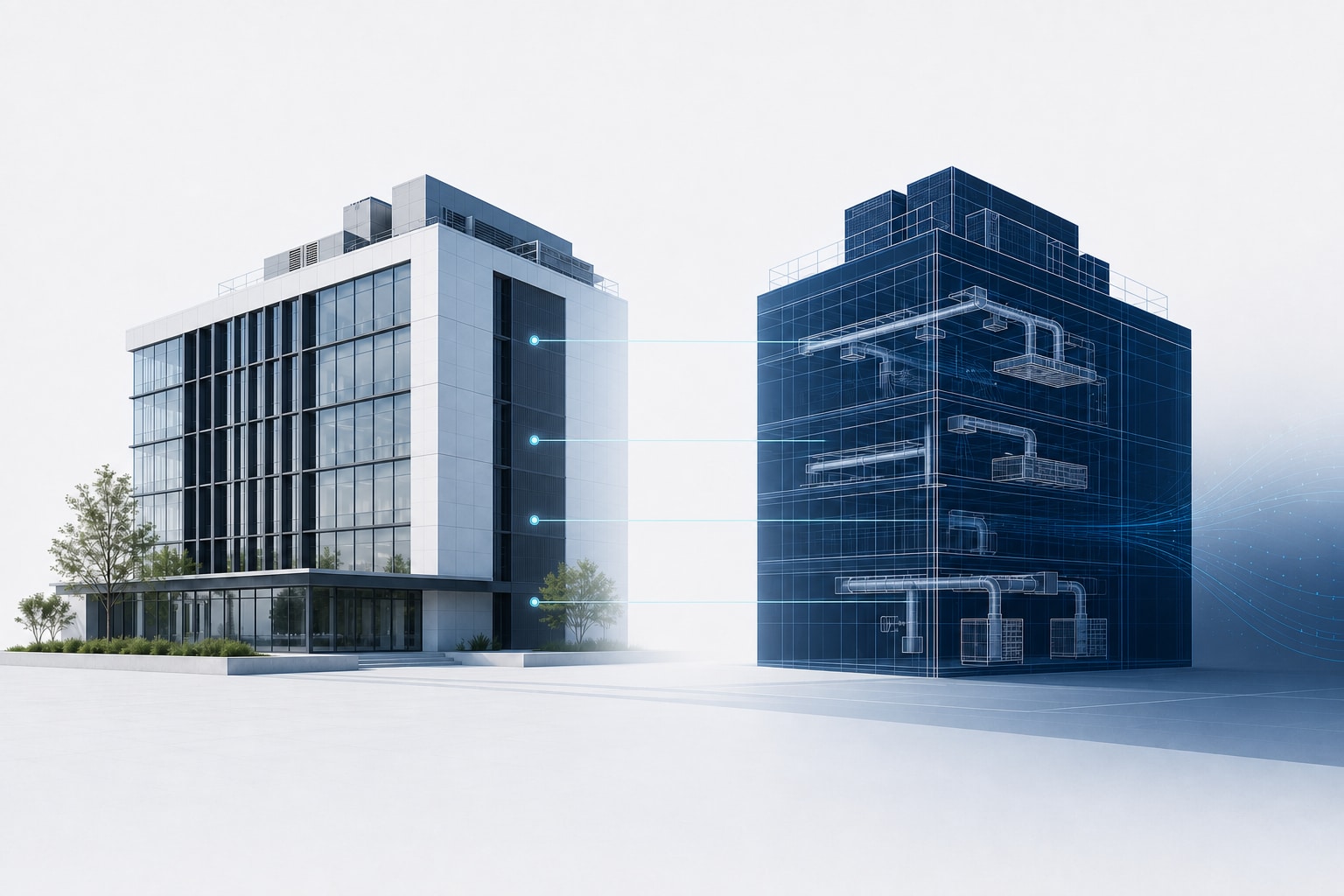
A digital passport is not BIM
Discussions about building digitalisation soon turn to BIM, 3D models, cloud platforms, BMS and central monitoring and control. These are all important tools. But a digital building passport is something different.
It is not just a model. Not a drawing archive. Not a folder of files. Not an attractive visualisation. And not a spreadsheet listing equipment.
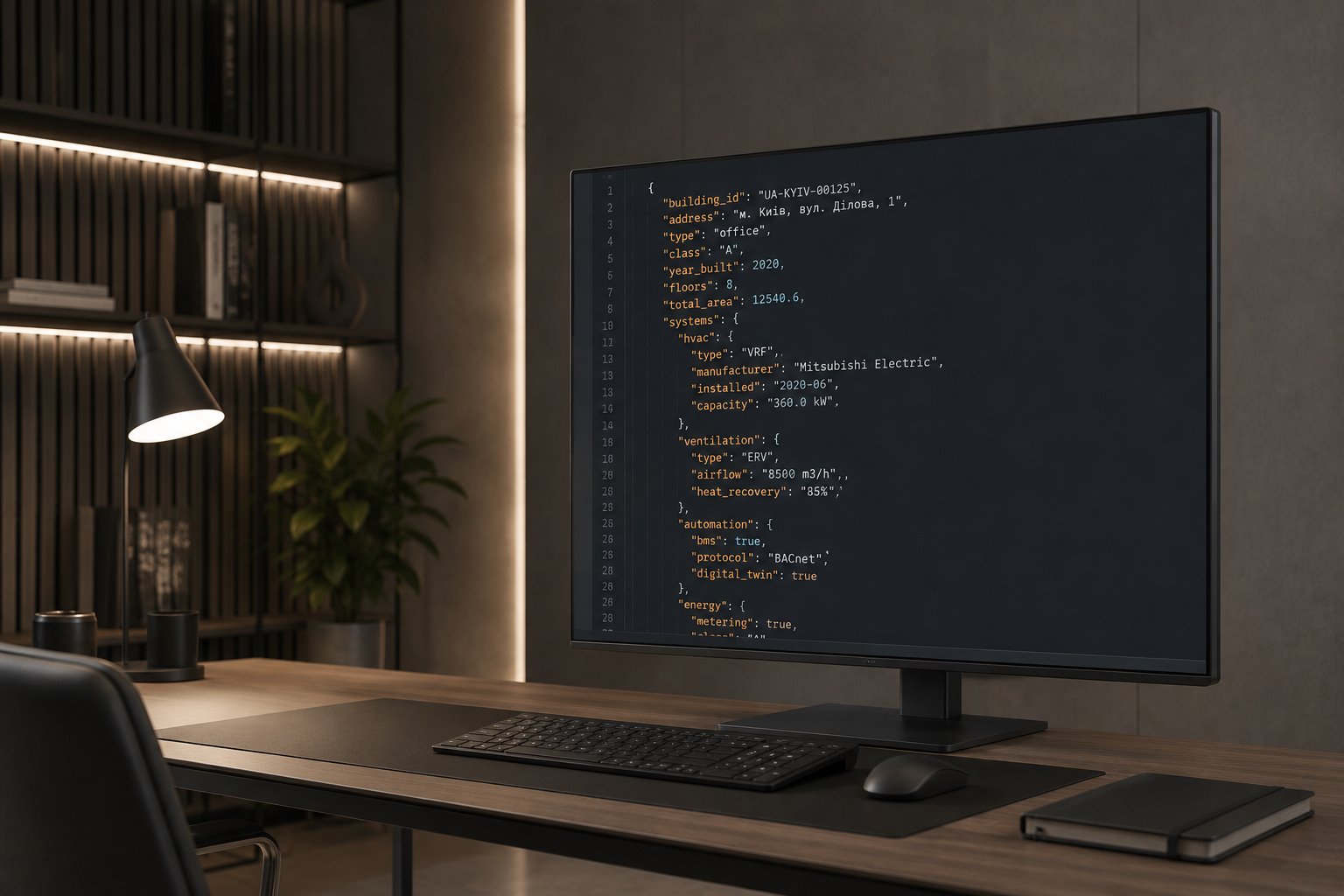
In my view, a digital passport should be a living document that explains the building's actual condition, the history of its changes and the reasoning behind decisions.
In other words, not only “what is installed”, but also “why it is this way”, “what has changed”, “what effects those changes had” and “where the risks lie today”.
What a building should know about itself
If we view a building as an asset, its digital passport should not answer technical questions for their own sake. It should help the owner, property management company, operations team, maintenance providers and a future buyer quickly understand the true picture.
Such a passport should contain more than drawings and equipment documentation. It should build up the building's engineering history:
- which systems are installed and how they are interconnected
- which settings form the baseline for normal operation
- what changes have been made since commissioning
- which upgrades delivered results and which did not
- which problems have recurred
- what levels of energy consumption are considered normal
- which decisions involved compromises
- which components require particular attention
- what spare capacity has been retained for future upgrades
This is no longer just technical documentation. It is the building's memory, enabling decisions without guesswork.
For the owner, it is a financial issue
At first glance, a digital passport may seem like an internal matter for engineers. In reality, it is about asset value.
When an owner does not understand the actual condition of the building services, they are buying uncertainty. They do not know what costs await them in a year's time. They do not understand where the weaknesses lie. They cannot quickly assess whether the building is ready for a new tenant, an upgrade, changes to operating modes or energy projects.
A building without an engineering history is always harder to sell and manage, because every decision starts with an investigation.
A digital passport is not there to fill an archive. It is there to reduce uncertainty around the asset.
A car often has a better history than a building
One thing has puzzled me for a long time. When we buy a car, we want to see its service history. When it was serviced. What was repaired. Which components were replaced. Whether there were recurring problems.
Yet a building worth millions or tens of millions of dollars often has no equally clear history of its building services.
We may have thousands of square metres, complex ventilation, air conditioning, controls, electrical systems, heat pumps and energy metering, yet no single clear record explaining how the building operates.
In the property market of the future, this will look increasingly strange.
AI will only increase the need for a building's memory
The more we talk about artificial intelligence, remote monitoring and analytics, the more important data becomes. But AI needs more than current operating parameters. It needs context.
Why does the system operate this way? Which operating modes are normal? When did the deviation appear? After which upgrade did its behaviour change? Which solution was temporary? Which component has long been operating at its limit?
Without this history, artificial intelligence will see only numbers. And numbers without context are very easy to misinterpret.
The digital passport as part of due diligence
I am almost certain that, over time, a digital passport will become part of standard property due diligence. Not a replacement for a technical audit, but a new layer of it.
A buyer or investor will want to see more than floor area, rental income and equipment specifications. They will want to understand how the building has operated over recent years.
Where failures occurred. What was upgraded. Which solutions delivered savings. Which problems remain. How stable the operating modes are. Whether there is an energy consumption history. Whether the operating data can be trusted.
Such information will gradually become part of what builds confidence in a property. And confidence directly affects value.
Key takeaway
A digital building passport is not another reporting requirement or a fashionable name for an electronic folder. It is an attempt to preserve what is most often lost today: understanding.
A building changes every year. It gains new tenants, new operating modes, new problems, new solutions and new compromises. If this history is not recorded, the owner has to start understanding their own asset from scratch each time.
The future value of property will depend on more than location, floor area and architecture. It will increasingly depend on how understandable, manageable and transparent the building services are.
A building's most valuable resource is not its equipment, or even its energy. It is an understanding of how it actually works.
Minimum record for a system change
You can start a digital passport with a single building services circuit and a change log. For each intervention, record:
- The date, equipment identifier and person responsible for the work.
- The reason for the change and a reference to the observation, service request or measurement.
- The before-and-after condition: settings, control algorithm version or component replaced.
- The verification method, result and outstanding issues handed over to the operations team.
This is a proposed structure for internal record-keeping, not the name of a mandatory regulatory document. It also requires someone responsible for updates, owner access and an export facility. It is this consistent history that makes a future assessment of the building's condition less dependent on assumptions.