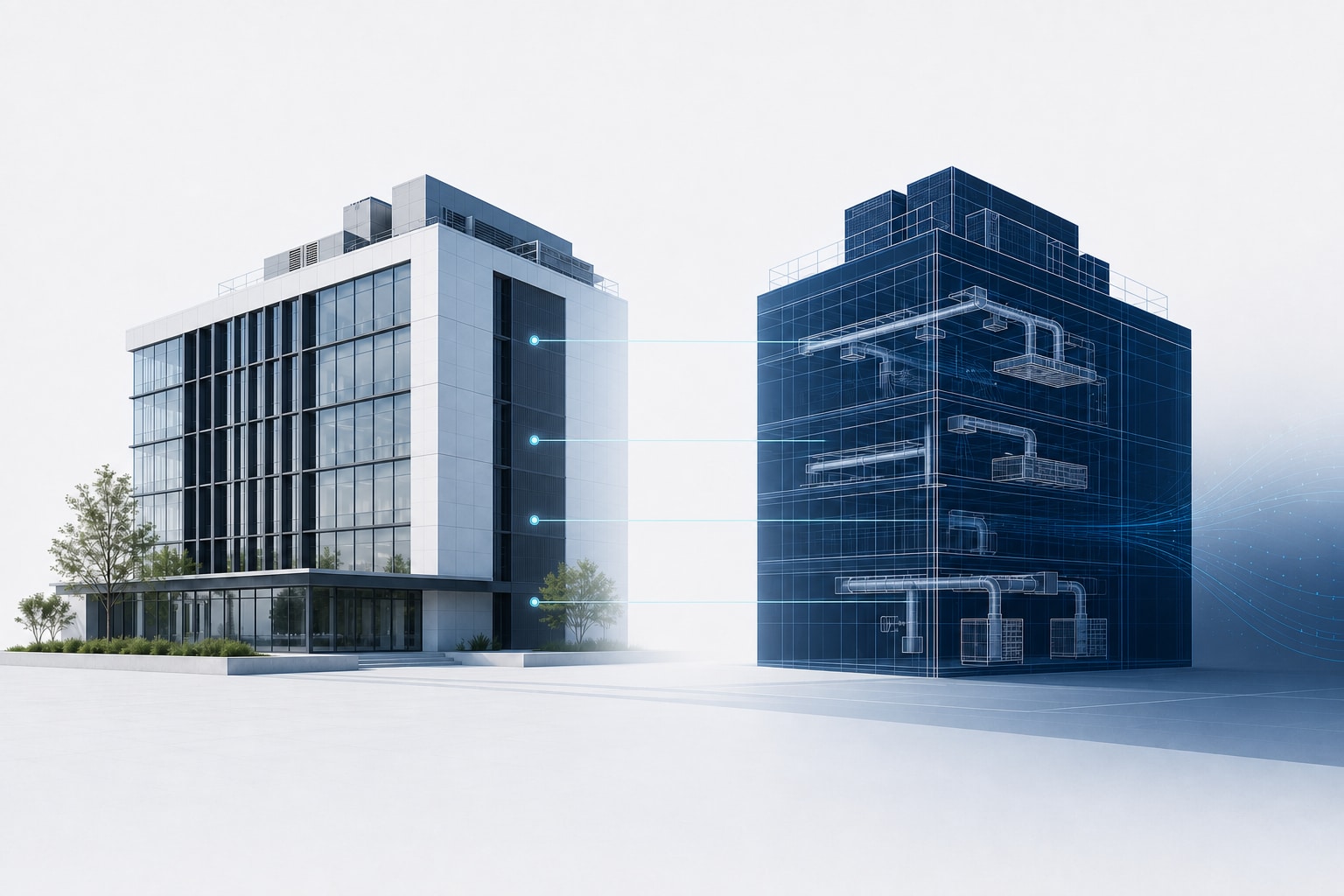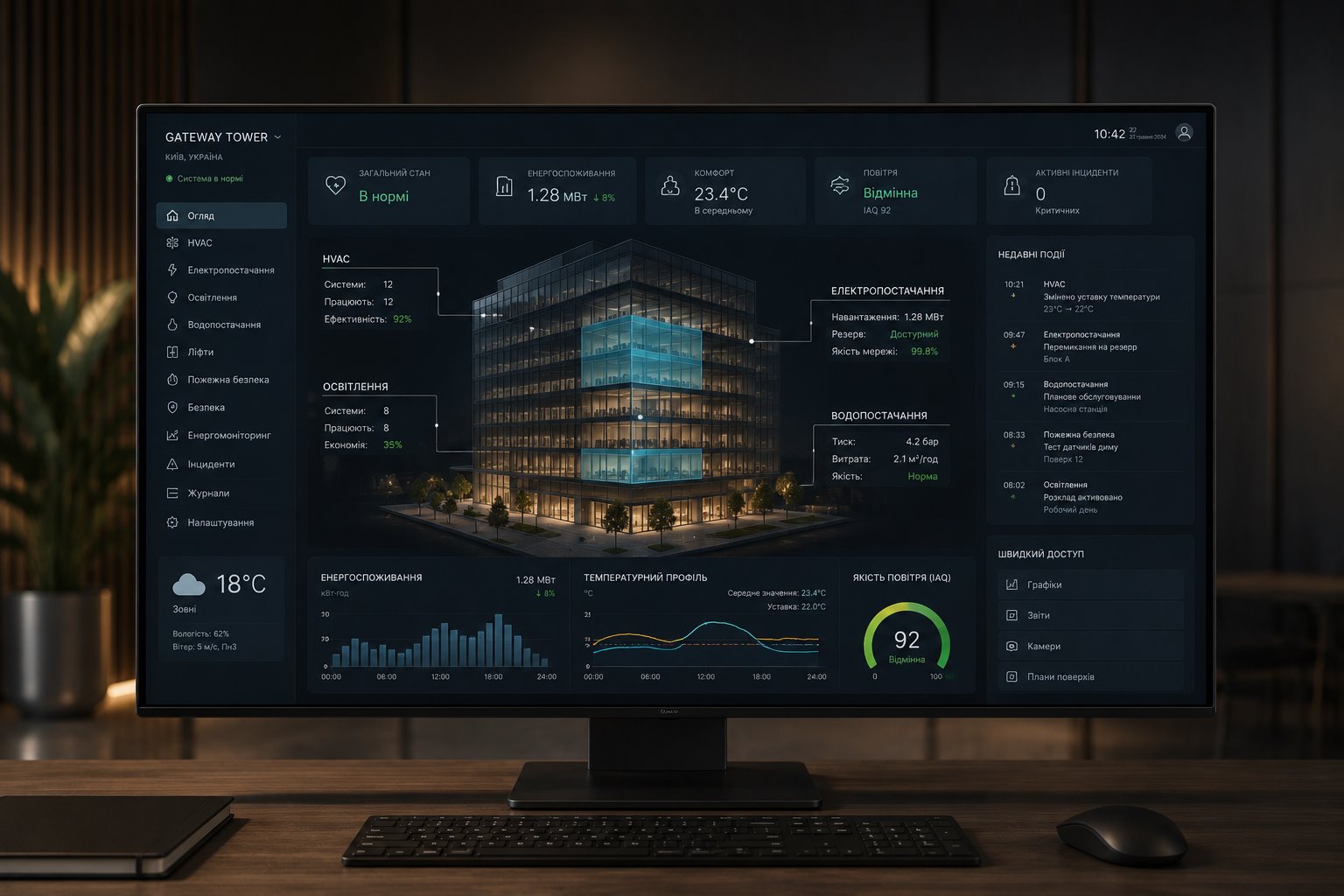
When people talk about building supervisory control, most picture a screen. An attractive system schematic. Graphs. Coloured indicators. Temperatures, alarms, pumps, valves and air handling units.
It looks modern in a presentation. But after a few years of operation, a simple and very uncomfortable question often arises.
Why does a building need another screen if it does not help the owner make better decisions?
A building does not make money from system schematics. It makes money through comfort, rent, visitors, reliable business operations and controlled costs.
The real value of supervisory control therefore does not begin with large quantities of data. It begins when those data become understanding.
Data alone are not management
I have seen facilities where the operator had access to thousands of parameters. Temperatures, pressures, statuses, graphs, alarms and event logs.
But when a simple question arose — why has this month’s electricity bill risen by 20%? — the system had no answer. It displayed data, but did not explain the cause.
The operator could see that the air handling unit was running, but not that it was running outside the facility’s actual operating hours. They could see the heat transfer fluid temperature, but did not understand the cost of deviating from the intended operating conditions. They could see an alarm, but not its business impact.
The system must answer ‘why’
In many buildings, supervisory control acts as a large monitoring dashboard. It faithfully displays what is happening. But that is no longer enough.
A modern system should help answer other questions:
- why the equipment is operating in this particular mode;
- whether this mode matches how the building is actually used;
- where the deviation from normal operation began;
- which system incurs the highest costs;
- what needs to change to achieve a result.
Not simply: the heat transfer fluid temperature has risen by 5°C. But: this has caused the system to consume more energy.
Not simply: the air handling unit ran at night. But: over the past month, this has cost the building tens of thousands of hryvnias.
Not simply: there is an alarm. But: this fault could affect tenant comfort or the operation of a restaurant, fitness club or retail area.
Supervisory control must speak the language of business
An engineer understands temperatures, air flow rates, pressure differentials, valve positions and fan speeds. A building owner often sees things differently.
- how much it costs;
- what risk it poses to the business;
- whether tenants are complaining;
- whether costs can be reduced without compromising comfort;
- what needs doing now and what can be scheduled for later.
That is why technical data need to be translated into the language of management decisions. A pump operating away from its optimum operating point is engineering information. The additional cost over a quarter is the language of business.
AI alongside the operator
In my view, the next stage in the development of supervisory control is not more attractive screens. Nor is it even more graphs. The next stage is intelligent assistance for the operator.
This is not about artificial intelligence running a building instead of people. That is a dangerous oversimplification. Managing a building carries too much responsibility simply to hand it over to an algorithm.
But AI can become a powerful assistant. It can do things that people find difficult to do continuously:
- analyse thousands of parameters simultaneously;
- compare building performance with previous periods;
- identify unusual operating modes;
- look for hidden energy losses;
- warn of the risk of faults;
- explain which deviations really matter.
The operator should not have to search manually for a needle in a haystack. The system should highlight what needs attention.
Not all alarms are equally important
Another problem with conventional systems is that they often present everything in the same way. A sensor fault. A unit shutdown. A temperature deviation. A schedule violation. Everything goes into a single stream of notifications.
But these events carry different weight for the business. One notification can safely wait until scheduled maintenance. Another may already pose a risk to a tenant, restaurant, server room or retail area.
Good supervisory control should do more than report an event. It should help establish its priority.
The most valuable screen is not the one that shows everything. It is the one that makes clear what matters.
Supervisory control as a decision-making system
I believe that, in the coming years, the value of supervisory control will be determined not by the number of points, graphs or system schematics, but by its ability to answer three simple questions.
- What is happening in the building right now?
- Why is it happening?
- How much is it costing the owner?
If the system does not help answer these questions, it risks remaining nothing more than an expensive screen.
If it does, it becomes a tool for managing the building, energy, comfort and risk.
Good supervisory control is not a data collection system. It is a decision-making system.
And the best supervisory control helps you do more than see the building. It helps you understand it.