Business centres
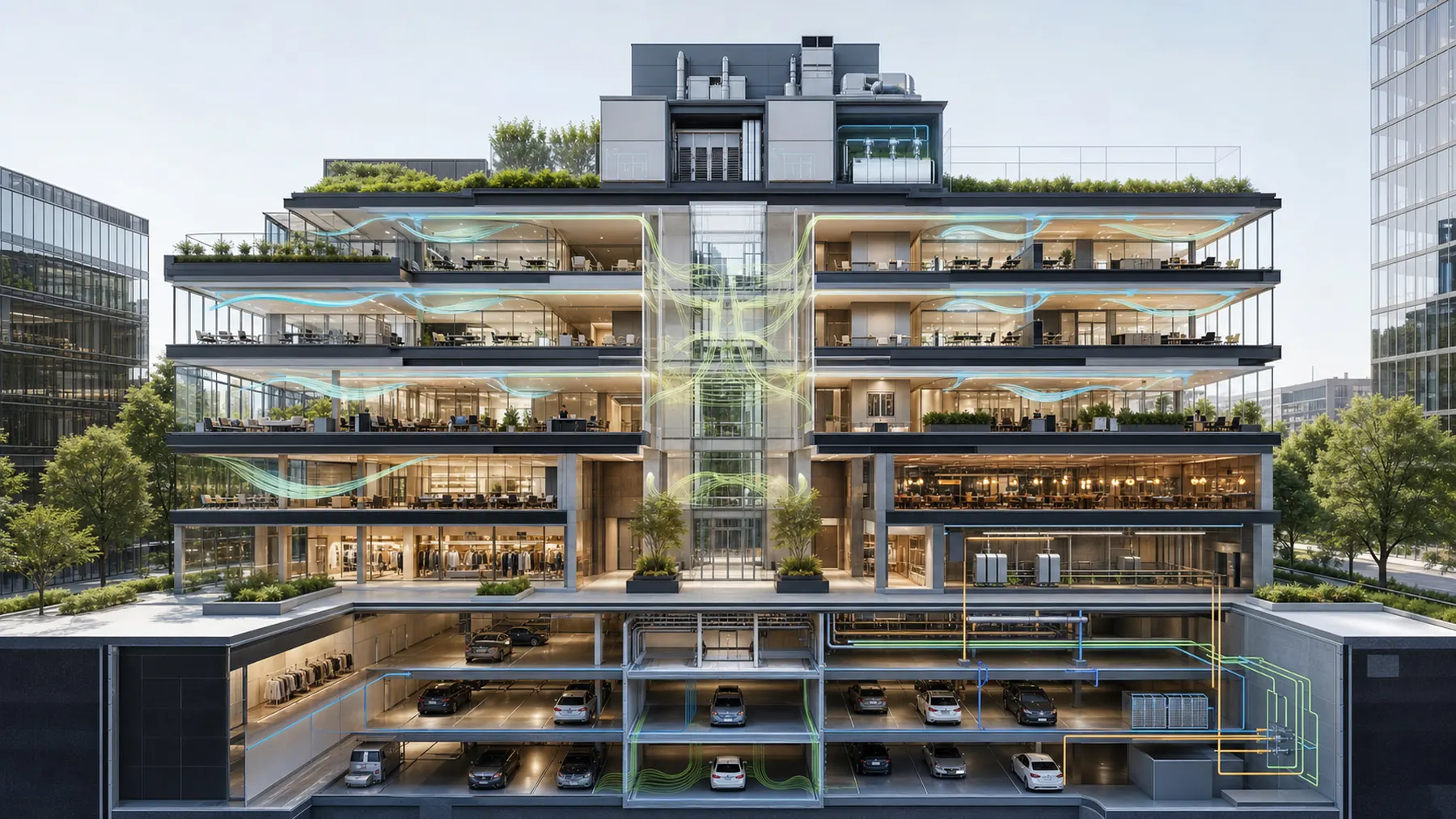
A central system serving floors and tenants with variable loads.

Central cooling
Central cooling for facilities where scalability, flexible hydraulics, redundancy and energy control matter.
System architecture is determined by more than peak capacity. We consider part loads, zone schedules, temperature regimes, pumping energy, redundancy and serviceability.
Facilities
The specific configuration depends on the architecture, operating modes, technical constraints and requirements for subsequent operation.
A central system serving floors and tenants with variable loads.
Many zones, long operating hours and requirements for centralised control.
Process cooling, redundancy, precise temperature control and year-round operation.
Tasks
We start with the outcome required by the owner and operations team, rather than a list of equipment.
We select the number of units, system configuration and staging algorithm.
We calculate flow rates, pressure differentials, balancing requirements and pump operation under variable conditions.
We incorporate redundancy for critical components, bypasses and failure scenarios.
Engineering approach
Each step reduces uncertainty and links design parameters to the building’s actual operation.
We develop a load profile, not just a single peak value.
We compare hydraulic arrangements, unit numbers and temperatures.
We determine the consequences of failure and the resilience required.
We define staging and controls to minimise costs.
Scope of works
We agree the scope before work begins, so the client understands the outcome, the boundaries of responsibility and how it will be verified.
Chillers, dry coolers, cooling towers, heat exchangers and operating modes.
Circuits, pumps, buffer storage, headers, control and balancing.
Fan coil units, air handling units, process equipment and temperature schedules.
Heat transfer fluid quality, expansion, make-up, filtration and protection.
Staging, setpoints, weather-based control logic, energy monitoring and supervisory control.
Flushing, testing, balancing and verification of algorithms and operating modes.
Interconnections
HVAC works as a system. That is why we link equipment, controls, servicing and operating scenarios.
In practice
Examples where the engineering approach has been tested through commissioning and subsequent operation.
FAQ
Brief answers to common questions before design or implementation begins.
HVAC AI
HVAC AI will clarify the loads, connected equipment, operating temperatures, and requirements for hydraulics, redundancy and controls.