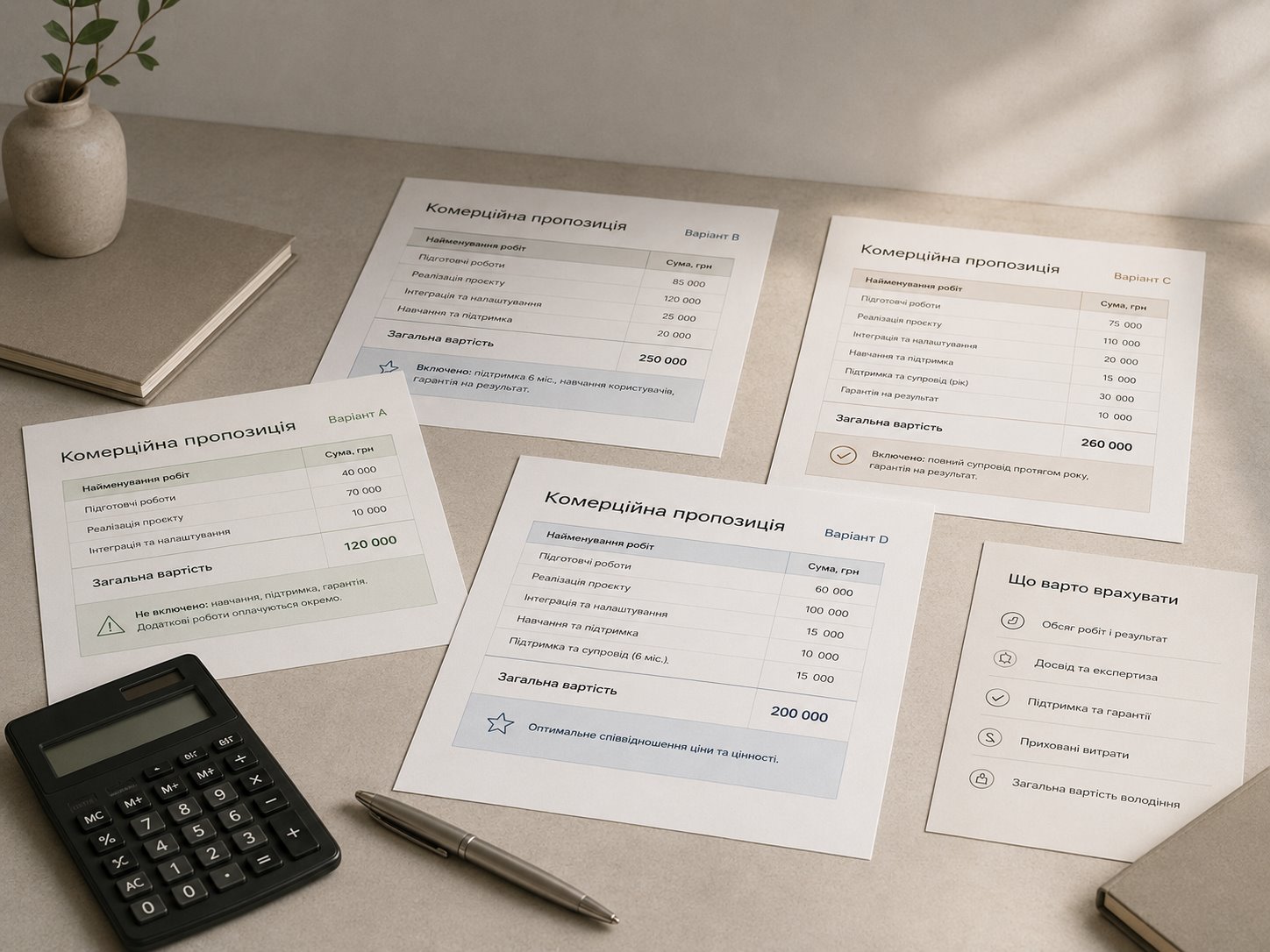
When a client puts building services systems out to tender, it all looks fairly straightforward. Several commercial proposals are on the table. One company offers to carry out the work for 12 million hryvnias. Another quotes 11.5 million.
A third quotes 10.8 million. The decision seems obvious. Why pay more for the same result? This is precisely where a story familiar to many property owners, developers and investors begins.
The illusion of savings
Most tenders are assessed very simply. The total figures in the commercial proposals are compared. Yet it is almost impossible to assess what lies behind them.
- How thoroughly has the contractor reviewed the design?
- Have they accounted for all the risks?
- Have they anticipated the actual conditions in which the work will be carried out?
- Have they included all the necessary materials and processes in the price?
The answers to these questions usually emerge only after the contract has been signed.
The most expensive word in construction is ‘extra’
At the tender stage, all participants understand the rules of the game perfectly well. The client compares figures. So whoever presents the lower price wins. Sometimes the difference between the winner and their competitors is only a few per cent. This creates a temptation to remove anything from the cost estimate that is not absolutely essential to winning the tender.
Not because the contractor wants to deceive anyone, but because the system often encourages exactly this behaviour. Once the contract is signed, a new stage begins. It turns out that completing the project requires work that was not included in the original proposal. Contract addenda appear.
Extra work. Extra materials. Extra approvals. And ultimately, extra costs. That is why ‘extra’ often becomes the most expensive word in construction.
The problem is not money
Most clients believe that the main risk in these situations is a budget increase. In reality, money is often only part of the problem. Time is a much more valuable resource. Every contract addendum means:
- new approvals
- new negotiations
- revised schedules
- delivery delays
- postponed facility opening dates
For a restaurant, this means opening later. For a shopping centre, lost rental income. For a manufacturing facility, a delayed business launch. For an investor, a longer wait to recoup their investment. That is why the difference between 10 and 11 million hryvnias in a tender can sometimes be far less of a problem than a delay of several months in bringing the facility into operation.
The client is not buying a price
Over twenty years of working on commercial facilities, I have reached a simple conclusion. What the client is really buying is not ventilation. Not air conditioning. Not a heat pump. Not even installation.
They are buying predictability. The ability to know in advance:
- how much the project will cost
- when it will be completed
- who is responsible for the outcome
In most cases, a business owner is far more comfortable working with a contractor who honestly states the true cost of the work than with one who wins the tender with the lowest initial price and then gradually recovers the difference through contract addenda.
Engineering contracting is not about equipment
There is often debate in the market about brands. Which manufacturer is better. Which equipment is more efficient. Which system is more advanced. Yet a project's success is very rarely determined by equipment alone.
Success depends on how well the work is organised. How well the contractor understands the facility. How effectively they can anticipate problems before they arise. How accurately they assess the scope of work before signing the contract. And how responsibly they honour their commitments.
That is why professional engineering contracting does not begin with installation. It begins with an honest assessment of the project.
The lowest price and the lowest cost are different things
The Ukrainian construction market is gradually maturing. More clients are beginning to assess contractors on more than just the figure at the bottom of a commercial proposal. This is a natural process. Because the cheapest bid and the lowest final project cost very often have nothing in common. Genuine savings arise when the client receives a predictable outcome without constant budget revisions, endless contract addenda or time lost resolving problems that should have been anticipated before work began.
And in my view, this is now becoming the main competitive advantage of a professional engineering contractor.