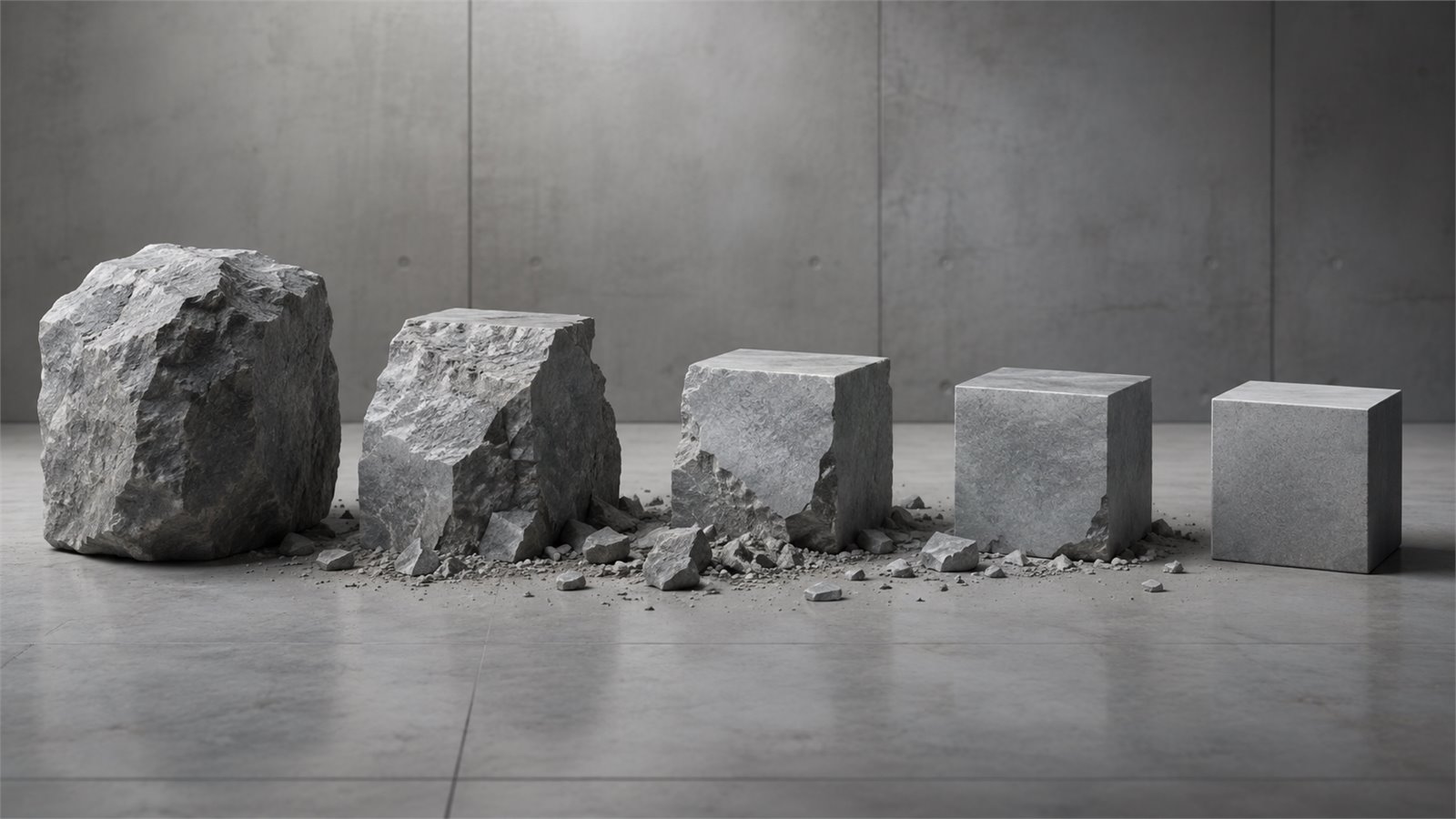
Inexperienced engineering has one characteristic trait: a complex solution seems more convincing. More equipment, more controls, more scenarios, more sensors, more circuits, more options for the future. As though the sheer number of components already proved the depth of thought.
I understand this reasoning well. Early in a professional career, complexity often feels like security. If we have added something, we have taken a precaution. If we have provided another operating mode, we have improved reliability. If we have installed more equipment, we have made the system more robust.
But experience brings a different perspective. Very often, the best engineering solutions look simple. Not because they are crude, but because someone has worked through the complexity and removed everything unnecessary.
True simplicity in engineering is rarely the first idea. More often, it comes after complexity.
The first version is almost always more complex
When we first start thinking about a system, the natural response is to add things. Add redundancy. Add a bypass. Add another sensor. Add an extra operating mode. Add controls for a situation that may never arise.
There is nothing wrong with this. A complex first version is often necessary. It reveals all the concerns, risks, expectations, extreme operating conditions and weak points of the future system.
The problem begins when this first complex version is treated as the final solution. When the design never goes through the second stage: stripping away the unnecessary.
Simplicity does not mean cheapness
It is important not to confuse simplicity with cost-cutting. Simplifying does not mean making something cheaper at any cost. It does not mean removing equipment simply to reduce the estimate. It does not mean abandoning necessary functions, redundancy or safety.
Simplicity in engineering is not about cutting back to save money. It is about clarity that delivers results.
Sometimes a simple solution can cost more at the design stage. It requires more experience, more analysis, more responsibility and more honest self-questioning. But in practice, such a system often proves more robust.
It has fewer arbitrary assemblies. Fewer unclear control algorithms. Fewer opportunities for the operations team to make mistakes. Less dependence on one person who once understood ‘how it was all intended to work’.
Adding another component is the easy part
Adding equipment is easy. It is much harder to say honestly: this is not needed here.
Because adding something appears to demonstrate care. Removing something means taking responsibility. You must explain why the system will be no worse without it. Why this assembly does not improve reliability but merely complicates operation. Why this scenario looks good on paper but has almost no practical value.
That is why good engineering solutions sometimes look almost unremarkable. They do not try to impress through complexity. They simply work. And that makes them seem obvious once someone has thought of them.
The hardest part of a simple solution is proving that what is unnecessary really is unnecessary.
But simplification always has consequences
This is where the line lies between mature simplicity and dangerous overconfidence. Almost any system can be simplified: remove a sensor, combine circuits, reduce the amount of equipment, dispense with some controls, reduce redundancy or change the control strategy.
But the key question is not what can be removed. The key question is different: what happens afterwards?
- how the system will behave at peak load in summer;
- how it will operate at part load in winter;
- what will happen when the building is partially occupied;
- how the solution will cope with changes in tenants or operating schedules;
- what will happen if one assembly fails;
- whether the operations team will understand this logic in five or ten years.
This is where real engineering begins. Not with the desire to make things simpler, but with the ability to anticipate the system’s life after that simplification.
A system must be simple to live with, not just simple for the engineer
Sometimes a solution seems simple only to its designer. They know the logic, remember every assumption and understand why the controls work that way and why the system components are connected as they are.
But then the building enters operation. Other people arrive. Staff change. Some documentation is lost. Tenants change the layouts. Someone installs new equipment. Someone requests a different operating mode. And a system that only its designer understood gradually becomes a problem.
Mature simplicity is therefore not just about a simple schematic. It is about straightforward future maintenance, diagnostics, control and accountability.
Simplicity requires depth
To make a system simple, you need a thorough understanding of its physics. How air moves. How loads change. How the heat transfer fluid behaves. How the system responds at part load. How the controls affect real operation, not just an attractive schematic.
That is why true simplicity almost always follows complexity. First, you see many options. Then you understand which are unnecessary. Then you see where redundancy is genuinely needed and where it merely masks uncertainty. Only then does a solution emerge that feels clear and logical.
From the outside, it may look simple. But within that simplicity lie experience, scenario testing and an understanding of the consequences.
For the owner, predictability matters more than complexity
A building owner does not need a system that looks clever in a presentation. They need a system that works, causes no unnecessary worry and does not become a puzzle for the operations team.
They need the building to remain manageable. The system must be maintainable. It must be possible to verify its performance. It must not depend on a single specialist. A change of tenant or refurbishment must not mean having to decipher the building’s entire engineering logic all over again.
That is why, for the owner, simplicity is not about an engineer’s aesthetic preferences. It means less uncertainty. Fewer hidden risks. Clearer operation. A longer, less troublesome building life cycle.
Not everything should be simplified
It would be a mistake to turn simplicity into a new religion. Some systems require complexity. Some facilities depend critically on redundancy. Some processes need multiple levels of control. In some buildings, excessive simplification creates more risks than benefits.
Maturity therefore does not mean always making things simpler. It means distinguishing necessary complexity from unnecessary complexity.
Necessary complexity serves the outcome. Unnecessary complexity works against the owner. It makes maintenance harder, increases errors, raises operating costs and makes the system less understandable to the people who have to live with it.
The key question is what happens next
When we simplify an engineering solution, we must see more than today’s schematic. We must see the system’s future life. Start-up. Its first winter. Its first hot spell. The first tenant complaint. The first breakdown. The first change of operations team. The first refurbishment.
Only then does simplicity become a professional solution rather than an attractive idea.
An engineer’s true skill is not in making a system simpler. It is in knowing exactly what will happen once it has been simplified.
For me, that is the sign of mature engineering. Not complexity designed to impress. Not cost-cutting simply to reduce the estimate. Not minimalism for the sake of an elegant idea. But a clear, controllable and responsible solution that remains understandable and robust when the building begins its real working life.
A quick check before simplification
For any component or algorithm proposed for removal, keep a brief record of the decision:
- Function: what the element does and how that function will be provided after the change.
- Scenario: how the system will operate at peak load, at part load and in the event of failure.
- Verification: which calculation or test will confirm that the required outcome is maintained.
- Operation: what will change in diagnostics, servicing, instructions and staff responsibilities.
If there is no answer, gather data first and simplify the system layout afterwards. It is also important to distinguish between spare capacity and redundancy for a critical function: apparently similar solutions protect against different risks.