
In many office buildings, the indoor climate problem looks very familiar. Someone is cold. Someone is hot. Someone calls the operator. Someone asks for it to be warmer. An hour later, someone else asks to change it back.
From the outside, it seems the building needs more automation. But often the opposite is true. There are controllers. There are sensors. There is centralised monitoring and control. The equipment is working.
What is not working is something else: the way people interact with the building.
We did not remove the operator. We removed the unpredictability that passed through them every day.
The problem was not the equipment
At one large office site, we encountered a typical situation. The VRF system runs reliably. The controls execute commands. The operator can see the system status. On paper, everything is in place.
Yet comfort is still a constant topic of discussion. One office asks for 23 °C. Another wants 25 °C. Someone changes the meeting room temperature before a meeting. In the open-plan office, people start arguing about who pressed what.
In this model, the operator becomes not a building services system operator, but an intermediary between people, their perceptions and the equipment. They spend the whole day dealing not with emergencies, but with minor everyday disputes.
Removing user control is too simplistic
The easiest approach is to lock everything down. Leave control solely to the operator. Take away the remote controls. Restrict access. Tell people: “Do not touch the system”.
But this is a poor solution. People should not lose influence over their own comfort. An office is not a plant room. People work there, and how they feel matters.
So the right question was different: how can we let people control their comfort without requiring them to make technical decisions?
Telegram became more than a remote control: it introduced a new way of working
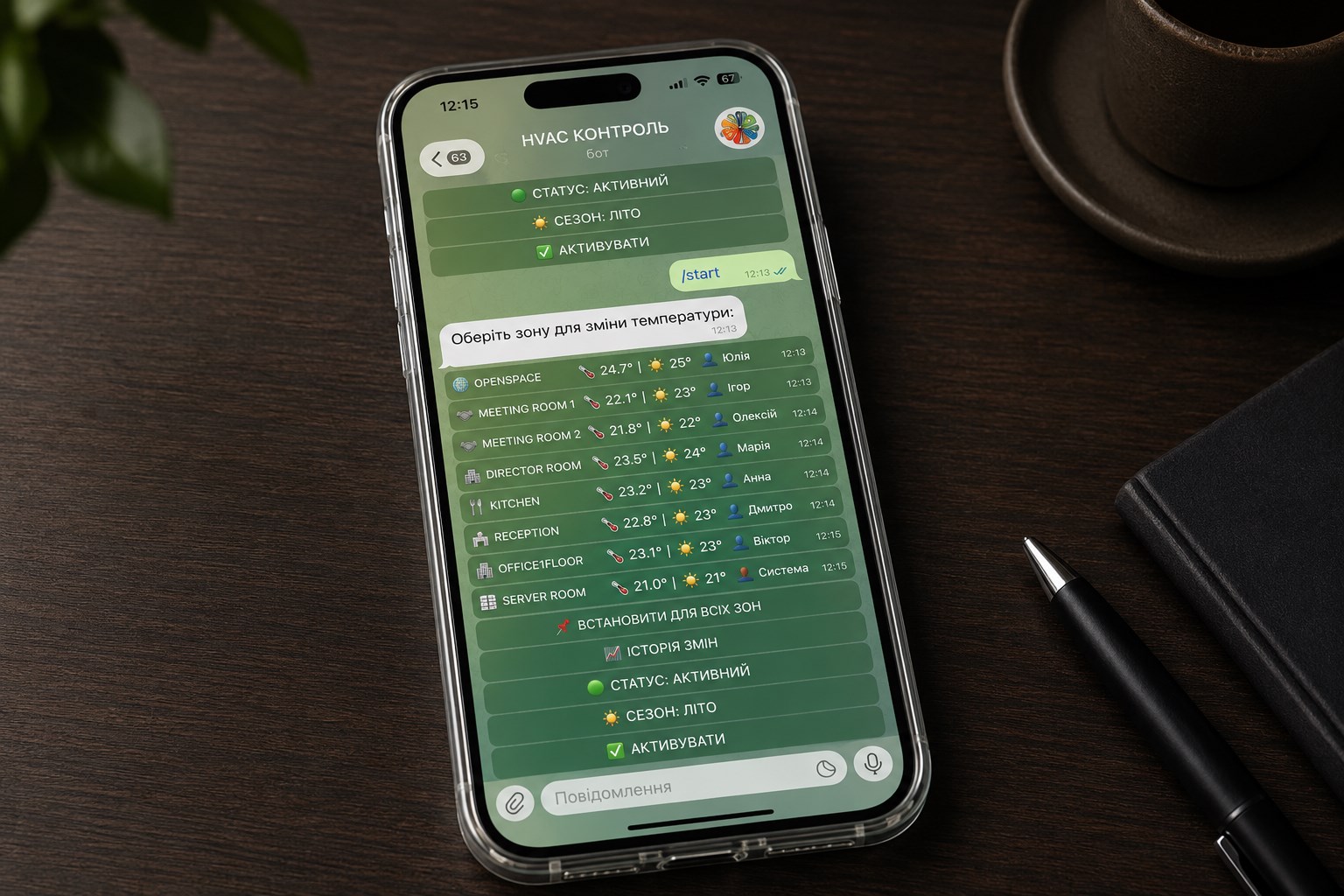
We gave employees the ability to control the indoor climate through Telegram. The user opens the bot, selects their zone and specifies the desired outcome.
They do not switch VRF modes. They do not think about fan speed. They do not decide whether cooling, heating, a pause or a limit on changes is best at that moment. They simply tell the building what comfort they need.
The system then takes into account:
- the current temperature in the zone;
- the operating mode of the entire VRF system;
- the season and outdoor temperature;
- the time of day and office schedule;
- the constraints of a system that operates in only one mode at a time;
- the permitted limits for temperature changes;
- the logic that prevents one user from compromising comfort for others.
The technical complexity remained inside the system. The user was left with a simple choice.
Transparency proved most important
After launch, an effect emerged that proved just as important as the automation itself. Everyone can see the most recent action.
If Yulia in the open-plan office wants 25 °C, everyone can see it. If Andrii changes the meeting room temperature before a meeting, everyone can see it. If Olena restores the settings afterwards, that is visible too.
Climate control decisions in the building were no longer anonymous. And with that, a significant share of the disputes disappeared.
The human factor did not disappear. It became manageable
It is important to be honest with ourselves: the human factor cannot be completely removed from a building. People will still perceive temperatures differently, wear different clothes, have different activity levels and sit in different places, near the façade or deeper inside the room.
But the human factor can be made understandable rather than chaotic. Instead of calls, verbal requests and random button presses, the system receives a structured action: who changed what, where and when.
This is no longer noise. It is data.
The operator did not disappear. They gained a proper role
We did not remove the person operating the system. We removed the minor, repetitive requests from their workload that did not require engineering intervention.
The operator no longer has to carry out every user request manually. They see the overall picture, manage exceptions, respond to genuine deviations and monitor the system rather than an endless stream of routine calls.
This is a completely different level of operation. Less manual noise. More control. Less unpredictability. More responsibility handled by the system.
Why this matters particularly for VRF
A VRF system does not respond well to chaotic commands. Especially if it operates in only one mode at a time and the whole group must follow the same logic: either cooling or heating. One ill-considered request can trigger a chain of consequences for other rooms.
The user does not know this, nor should they need to. They are not an engineer. They simply want the room to feel comfortable.
That is why an intelligent layer is needed between people and equipment. Not to take control away, but to prevent an everyday preference from turning into a technical error.
The best automation is the kind people stop noticing
Some time after launch, the best indicator was very simple: people stopped discussing the technology itself.
At first, everyone finds it interesting that they can control the indoor climate through Telegram. Then it becomes routine. Like Wi-Fi. Like an electronic access pass. Like booking a meeting room.
And that is a good sign. Because effective automation should not have to prove its existence every day. It should quietly eliminate unnecessary actions, errors and conversations.
The user should not see the engineering complexity. They should see a simple result.
What the building owner gains
For the owner or managing agent, such a system is more than a convenient interface. It changes the quality of building operation.
It provides:
- fewer calls to the operator;
- fewer arbitrary mode changes;
- a transparent history of user actions;
- clear zone control;
- fewer disputes between employees;
- more stable equipment operation;
- data for analysing recurring complaints;
- a greater sense of control over the building.
As a result, the building becomes more than automated. It becomes easier for people to understand.
This is not about Telegram
It would be easy to say this is an article about a Telegram bot. But it is not.
Telegram is simply a convenient channel already in every employee’s pocket. The point is not the messaging app. It is that the building gained a new level of communication with people.
Previously, a person would either call the operator or press something on a local controller. Now they interact directly with the building’s logic, but without access to potentially harmful technical decisions.
A final thought
This project matters to me not because we used Telegram. Nor because we created a convenient interface.
Something else matters more: we changed the very way people interact with an office building.
People retained influence over their own comfort. The operator stopped being an intermediary for every minor change. The system gained rules, limits, a history and transparency. And the building began to run more smoothly.
We did not take control away from people. We removed their need to make technical decisions that the building services system should be making.
In my view, this is exactly how modern building automation should evolve. It should remain complex on the inside, but be so simple for people to use that they barely notice it.