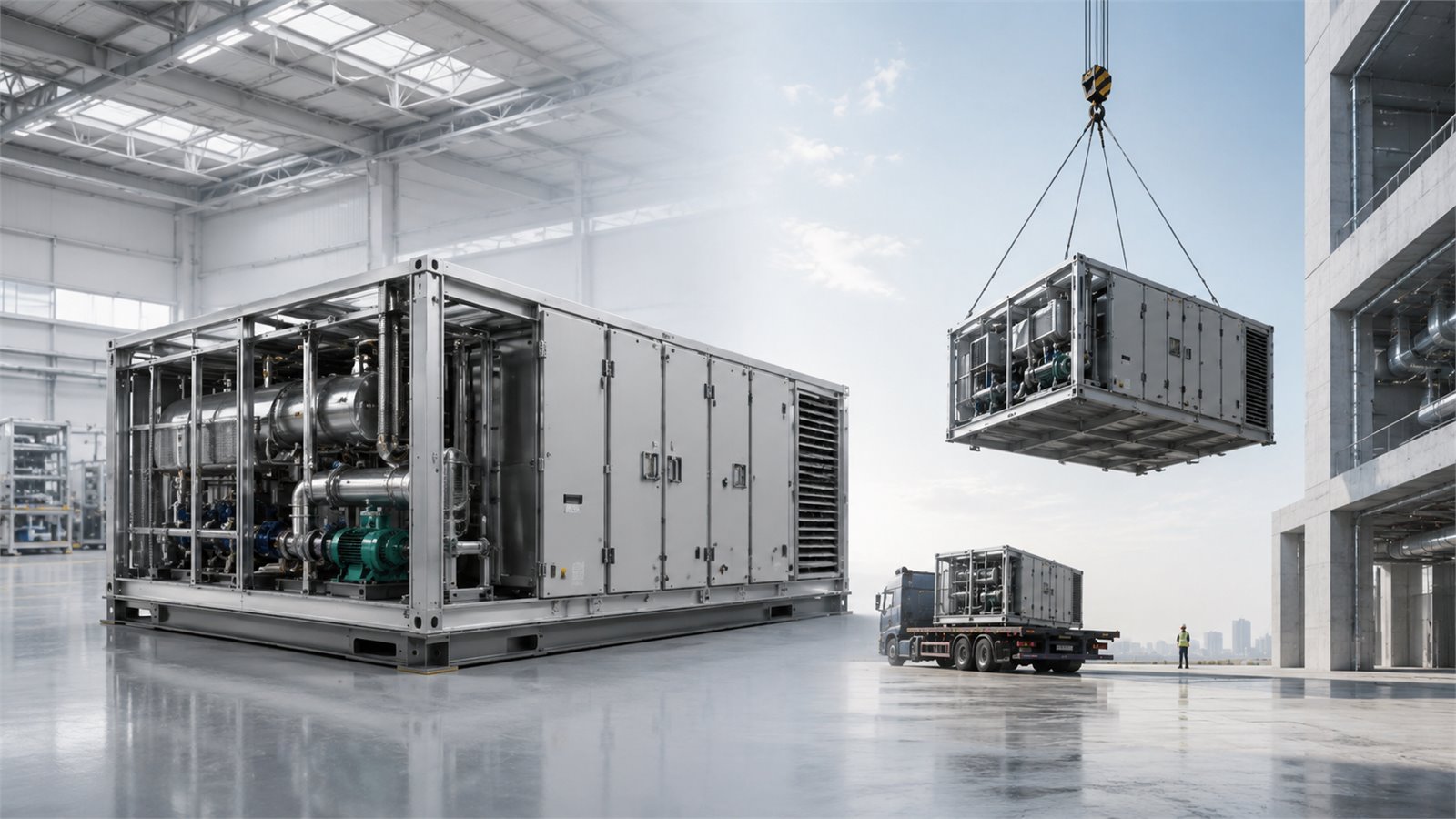
There is an uncomfortable truth in construction that rarely features in presentations. The more complex operations are left to the construction site, the less predictable the outcome becomes.
On paper, everything looks tidy: the design, programme, specification, team, contractors and deadlines. Then the reality of the site takes over. Rain, dust, staff shortages, different crews, delays by other trades, rework, lack of space, last-minute changes and thousands of manual operations, each a potential source of error.
That is why the principle of maximum prefabrication is gaining ground worldwide. The idea is very simple: anything that can be assembled, tested and prepared to a high standard in a factory should not require heroic efforts to put together on site.
A construction site is a poor place for manufacturing. It is a place for installation, assembly and commissioning.
The problem is not the people
When something goes wrong on site, the simplest explanation is always the same: someone made a mistake. The installer did it incorrectly. The crew did not read the drawings properly. The site supervisor failed to check. The supplier was late. The operations team had to finish things off afterwards.
But often the problem is not with particular people. It is with the approach itself. We are trying to carry out too many manufacturing operations in an environment poorly suited to them.
A factory operates under controlled conditions. It offers repeatability, tools, test rigs, inspections, a consistent sequence of operations and accountability for the result. A construction site works differently. Every day is slightly different.
What the client is really buying
At first glance, prefabrication seems to be about faster installation. And that is true. A ready-made assembly, module or cabinet can be installed much faster than it can be built from individual components on site.
But for the property owner, the main value is not just speed. It is predictability.
The client has a clearer understanding of exactly what they will receive, when it will be ready, how many people are needed on site, what risks remain and what has already been tested before delivery.
On large projects, this has a direct financial impact. Every day of delay can mean tenants starting operations later, a postponed opening, additional construction management costs or disputes between contractors.
Prefabrication does not sell a module. It sells less uncertainty.
HVAC is particularly well suited to this approach
Engineering systems are one of the best applications for this approach. Air handling units, pump sets, pipework assemblies, control panels, heat substations, cooling plant, containerised solutions and modular plant rooms can all be prepared to a much higher standard before they reach the site.
This is particularly important where there are many repeated assemblies. Retail chains. Hotels. Office buildings. Industrial facilities. Data centres. Buildings where the priority is not a single heroic achievement, but consistently repeatable quality.
For HVAC, this means less uncoordinated on-site assembly, fewer joints, fewer ad hoc decisions, less dependence on the particular crew on shift and more control before installation even begins.
- faster installation;
- fewer people on site;
- lower risk of errors;
- better quality of repeated assemblies;
- simpler commissioning;
- clearer accountability;
- less remedial work after start-up.
But prefabrication does not begin in the factory
There is an important point that is often underestimated. You cannot simply decide at the end of a project: let us make everything modular. Maximum prefabrication begins much earlier — during concept development, design and coordination.
It requires precise design decisions, proper detailing, coordinated openings, clearly defined dimensions, logistics, maintenance access, an installation plan and a realistic understanding of how the module will be brought in, connected and commissioned.
Prefabrication is therefore not just about manufacturing. It is a planning culture. It requires the client, designer and contractor to make decisions earlier and coordinate more effectively.
Less heroism, more systematic working
Construction has long valued the ability to ‘sort things out on site’. Sometimes this really does save a project. But if a project constantly relies on heroics, the system is not organised properly.
Mature engineering should not aim to have people on site overcome chaos every day. It should aim to reduce that chaos from the outset.
This is where maximum factory completion becomes not a technical detail, but a way of managing capital. The owner pays not just for equipment, but for speed of delivery, quality, risk control and fewer surprises during commissioning.
The nature of construction is gradually changing
I believe this approach will gain ground in the coming years. Not because it is fashionable, but because objective factors are pushing the market in this direction: a shortage of skilled people, demanding deadlines, more expensive downtime, more complex systems and a higher cost of mistakes.
The construction site of the future will look less and less like a place where everything is built from scratch, and more like a place where precisely assembled, tested and coordinated modules are brought together into a single system.
The best building services system is not one completed through heroic efforts on site. It is one that arrives on site as ready for operation as possible.
Maximum factory completion is not about taking work away from the construction site. It is about leaving the site to do precisely the work it should do best.
The 20th century learnt to mass-produce cars. The 21st century is gradually learning to mass-produce buildings. And building services systems will be among the first to experience this change in practice.