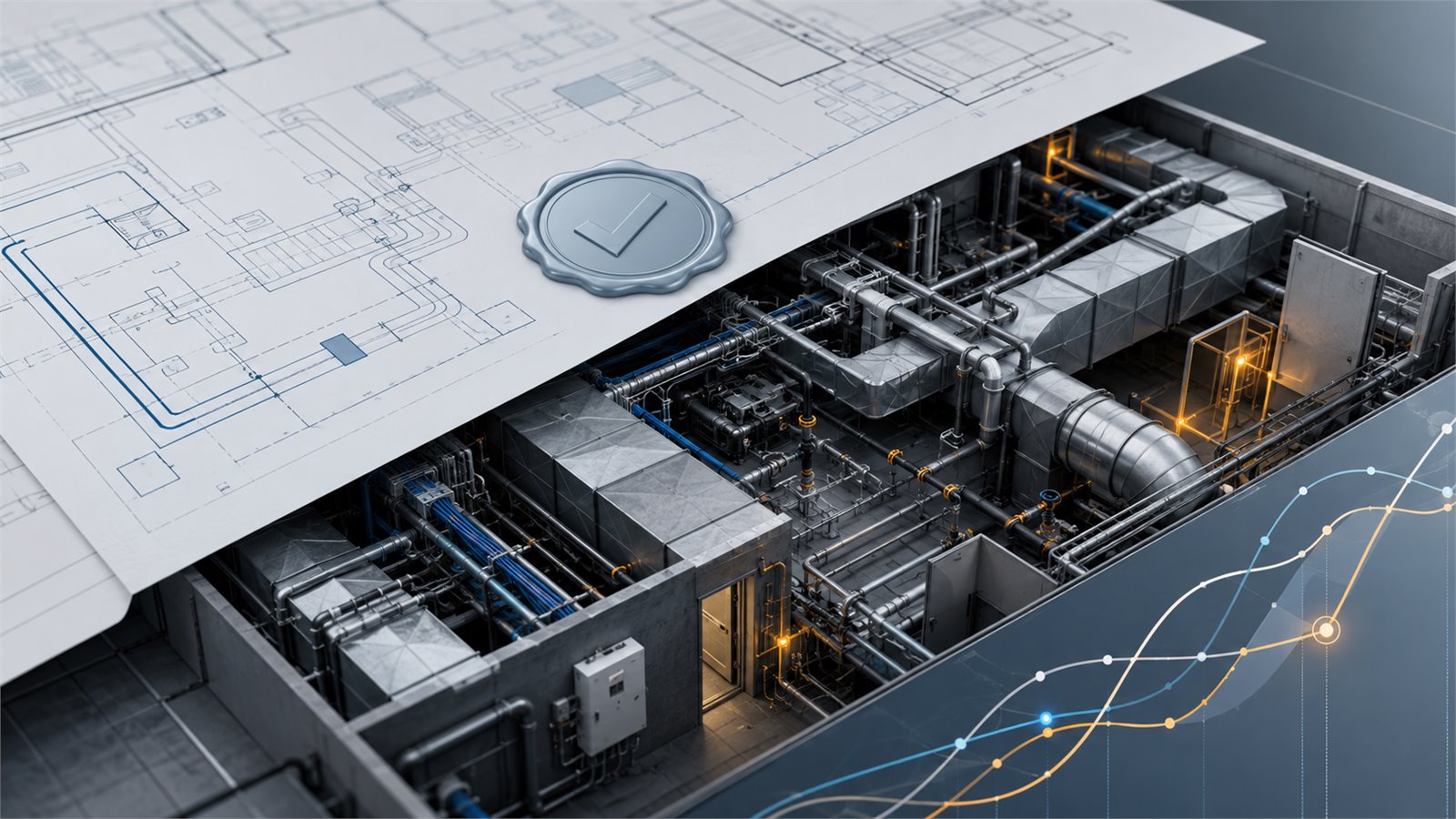
In construction, one phrase often sounds like the final word: ‘The design has passed expert review.’ Many people then assume that all the main questions have been settled.
Formally, this is indeed a strong argument. But in engineering, there is an important distinction. A design can comply with regulations yet still not be the best solution for the owner, the operations team or the building’s future financial performance.
An official expert review answers the question of whether a design meets the requirements. But it does not always answer whether the building will be convenient to use, economical and manageable in ten years’ time.
What an official expert review checks
An official expert review serves a very important purpose. It checks the design’s compliance with regulations, safety standards, mandatory requirements and basic parameters, as well as the formal correctness of the proposed solutions.
Without this, the market cannot function properly. Construction cannot rely solely on the designer’s opinion, the client’s wishes or the contractor’s confidence. There must be a formal system of oversight.
But problems begin when the client confuses two different concepts: ‘the design complies with regulations’ and ‘the design is the best solution for this building’.
Regulations do not account for your business model
The regulatory framework does not know exactly how the owner plans to generate income from the building. It does not know whether spaces will frequently be reconfigured. Whether tenants will change. Whether rapid servicing matters. Whether downtime is critical. Whether the building will operate during the day, at night, seasonally or under varying load patterns.
That is why a design can be formally correct but economically weak. It can pass expert review while still creating unnecessary installation costs, maintenance complexity, problems with future alterations or high operating costs.
This does not mean the expert review is poor. It means it serves a different purpose.
There is another kind of review
Alongside the official review, there is another kind. Not a state review. Not a formal one. The kind that procedures do not usually require, but real life soon does.
This is a review of future operation, costs, risks and common sense. It looks at the design not as a set of documents, but as a future building that must function for many years.
Here, the questions are very different:
- will the equipment be easy to maintain
- will it be possible to identify the cause of a problem quickly
- will the system become too expensive to operate
- will the solution accommodate changes in tenants and layouts
- will the actual operations team understand the controls logic
- does the design build in costs that the owner will bear for years
An official expert review is often not required to answer these questions. Yet they are precisely what later determines whether the building will be a trouble-free asset or a constant source of expense.
Operations teams inherit more than paperwork
Once a building is brought into operation, nobody operates the drawings. They operate real service routes, valves, drains, controls, access arrangements, filters, pumps, cables, sensors and operating sequences.
This is where issues that looked acceptable on paper become apparent. The equipment is there, but access is awkward. The controls are there, but do not help deliver the required results. The system works, but every change of tenant turns into an expensive refit. Air is supplied, but comfort varies between zones. Energy is consumed, but nobody understands exactly where it is being wasted.
This is not about criticism
It is important not to confuse this approach with criticism of the official expert review. Its role is different. It is not meant to replace strategic engineering thinking on the owner’s behalf. It is not meant to calculate the full life-cycle economics. It cannot know every business plan for the building.
But owners, developers and investors need to understand that passing expert review does not mean the design is already optimal. It means it has received formal confirmation of compliance with the requirements.
The next question is different: is this really the solution the building should live with for the next ten, fifteen or twenty years?
How my review differs
When I examine an engineering design, I am interested not only in whether it can be implemented. I want to know what will happen afterwards.
How much it will cost to operate. How quickly the service team can respond to problems. Whether the next team will understand the system. Whether the building can be upgraded without undoing half the existing solutions. Whether the owner is buying savings today that will turn into costs a few years later.
This is a different perspective. Not a replacement for the official expert review, but a complement to it. Because a business needs more than a design that passes inspection. It needs a building that will not consume unnecessary money, time and attention year after year.
Expert review is not the finish line
That is why I stopped treating expert review as the final word a long time ago. It is an important stage. A mandatory stage. But not the end of the discussion about quality.
A design that has passed expert review has been cleared for implementation. But clearance for implementation does not guarantee trouble-free operation.
A good engineering design must stand up to more than a document review. It must stand up to the realities of the building’s life.
It is there, after years of operation, that it becomes clear whether the design was merely correct on paper or genuinely sensible for the owner.