
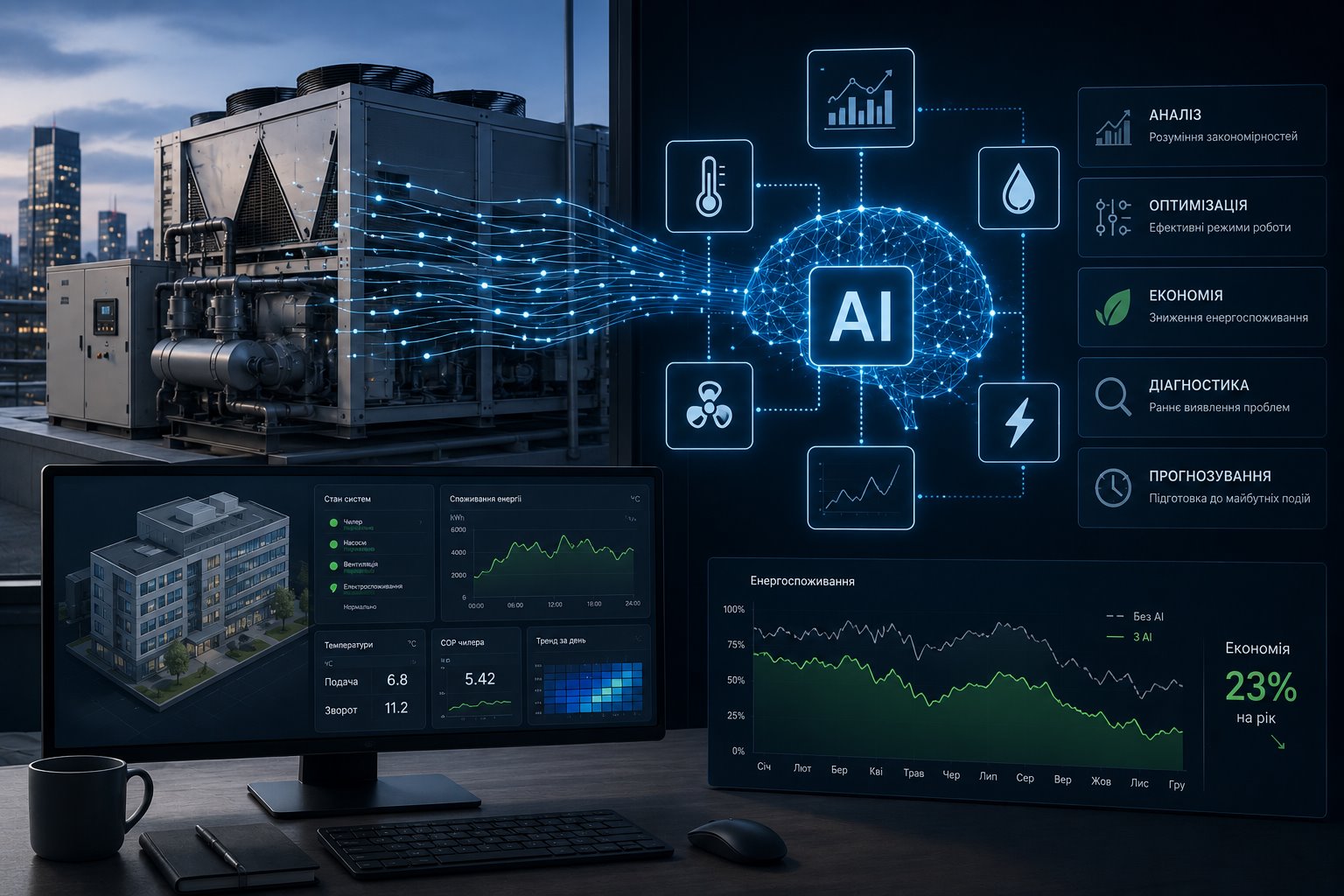
When a building owner hears about artificial intelligence in building services, the first reaction is usually predictable: it must be expensive. The controls will need replacing, new controllers installed, a new chiller and new sensors purchased — effectively rebuilding the system from scratch.
That reaction is understandable. In building services engineering, we are used to any major technological advance starting with new equipment. A new compressor. A new pump. A new heat recovery unit. A new supervisory system.
But AI is different. Artificial intelligence does not necessarily begin with removing the old equipment. Very often, it starts with a much simpler question: what do we already know about how this building operates?
AI does not need a perfect new building. It needs data, operating history and access to real operating processes.
The most expensive equipment is already installed
In many commercial buildings, the main investments in building services were made long ago. The chillers are in place. The pumps are running. The fan coil units are installed. The air handling units are connected. The controls are there. The cables have been laid. These systems have kept the building running for years.
This raises a very practical question for the owner: is a complete equipment replacement really the right starting point, when the main problem often lies not in the equipment itself but in how it is controlled?
An old chiller may not have the best efficiency on its datasheet. But if it runs at the wrong times, in the wrong load range, alongside poorly configured pumps and ventilation, its age is not the main source of waste. The problem lies in the system’s operating logic.
A building can be functional and inefficient at the same time
This is one of the most important points, and it is difficult to explain without practical experience. A building services system can have no breakdowns, display no critical faults and receive regular servicing, yet still perform worse every day than it could.
Pumps may circulate more water than necessary. Ventilation may follow an old schedule that no longer reflects actual building occupancy. A chiller may start earlier than needed or maintain an operating mode longer than the actual load requires. Some zones may overheat while others are overcooled.
On paper, everything works. There is no crisis in the control room. But the owner pays for energy, equipment wear, tenant complaints and unnecessary work for the facilities team.
These are precisely the losses AI can identify better than a person. Not because it is smarter than an engineer, but because it can continuously analyse thousands of parameters and find patterns that are hard to spot in day-to-day work.
Data matters more than equipment age
For AI, a chiller’s age is less important than whether its behaviour under real conditions can be observed. When it starts. What load it operates at. How it responds to the weather. How it interacts with pumps, ventilation, fan coil units, tenant schedules and electricity tariffs.
If these data are available, even an old system becomes a valuable source of information. Without data, even a new building remains almost invisible to AI.
Artificial intelligence does not work with equipment brands. It works with system behaviour.
That is why the question of future efficiency will increasingly shift from ‘What equipment is installed?’ to ‘Can we see enough to manage the building intelligently?’
Modernisation can start at the supervisory level
Many older buildings do not need an immediate, complete replacement of their building services. They need a different level of control. Additional telemetry. Stored operating history. Effective supervisory monitoring. Open protocols. Analytics. New logic layered over the existing controls to support better decisions.
This does not mean equipment never needs replacing. Sometimes it does. An old chiller may be physically worn out. Pumps may have been incorrectly sized. Controls may be closed or technically obsolete.
But the important point is this: replacing equipment is no longer the only route to modernisation. Today, a building can be made smarter without immediately turning the project into a major capital refurbishment.
AI as a capital management tool
For an investor or building owner, AI is valuable not as a technology trend but as a capital management tool. Every building services system involves more than its purchase cost. It entails years of energy consumption, servicing, repairs, downtime, complaints and operational decisions.
If AI helps reduce unnecessary equipment running hours, identify incorrect operating modes, prevent a breakdown, plan servicing better or reduce manual intervention by the facilities team, its impact goes beyond an attractive presentation. It affects the finances.
This is precisely where older buildings can offer enormous potential. They already have a history. Seasons of operation. Faults. Recurring complaints. Real operating patterns. Accumulated experience that often no one has analysed systematically.
The challenge is not AI. It is preparing the building
The hardest task in the coming years will not be finding an algorithm. Algorithms will emerge. Software products will emerge. Analytics platforms will become more accessible.
The much harder task is preparing the buildings themselves. Making data accessible. Putting supervisory monitoring in order. Identifying which parameters really matter. Establishing who is responsible for decisions. Above all, moving from responding to breakdowns to managing outcomes.
Without this, AI will become yet another attractive add-on that displays graphs but does not change day-to-day operation.
The future of HVAC does not begin with a new chiller. It begins with an honest view of how the old one operates.
So the key question for a building owner today is very simple: do we understand the building services systems we have already bought, installed and pay to operate every day well enough?
Where that question is answered honestly, AI can deliver real value. Not as a fashionable technology, but as a new level of management for the building, its energy use, its service life and the owner’s money.